


What’s it like for men who work at a Czech company that takes fatherhood seriously? From Heroine.
Care for them, play with them, fix everything that bothers them. Most Czech men who would like to spend more time with their young children can’t do so without the family losing money. Apart from the state’s generous support for mothers, some private companies are experimenting with radical ways to help out new fathers.
Jozef Brnan, 33, who makes a living as a software developer, is enjoying the fruits of such a policy. In March last year, his employer introduced a benefit in the form of half a year of fully paid parental leave, which either the father or mother can use until the child reaches 18 months of age. Jozef thus has the opportunity to be much more involved in the care of his nine-month-old son and to help his wife Marcela, who is on traditional maternity leave.
According to him, thanks to the benefit, he was able to take care of the little boy much more intensively than if he only had time to put him to sleep, play, and feed him after eight hours at the computer. “I spread the total time off into shorter periods every few months, which seems like a great option to me. When I was home, my wife and I split the tasks. I mainly did parenting duties at night so that my wife could sleep. In the early morning and forenoon, we switched.”
Immediately after the birth of his son, Jozef took two months off. He planned to take the remaining months this summer and then again at the end of the year. “It would definitely take me a lot more time to learn how to take care of my son if I was at work all day to begin with. Plus, it’s a lot less stressful when there are two of you,” he points out.
Other Czech dads would also like the opportunity to spend much more time with their young children: according to the Czechia in Data survey, 70 percent of men would like to spend at least part of their parental leave at home with their child. However, over 50 percent of them are concerned about how the family would manage this financially.
Key Life Moments
Jozef works for the Czech branch of the international financial technology firm FNZ. He is at home on full salary, without financial concerns. The New Zealand company had been planning this extensive support for parents for a long time, and the introduction of the benefit across all its worldwide branches was managed directly from the Czech Republic by FNZ’s head of human resources, Renata Mrazova. Her team began working on the launch in the summer of 2022.
“As we developed it, we thought about what is actually important to our employees. Many companies offer various benefits. We decided to support our employees at key moments in their lives. We will make them financially comfortable so they can manage them,” the experienced manager says.
“When I joined FNZ in January 2023, preparations were already underway, but I have been the key liaison officer since I started,” she explains. “We operate in more than 30 markets, so any kind of across-the-board measure is inherently a big project,” Mrazova says over the phone as she moves from the company’s Prague offices to Brno, where FNZ opened its first Czech headquarters in 2010. From there, the firm serves a number of international clients who use its online wealth management system – mainly banks and other financial institutions.
Given FNZ’s global reach, Mrazova says it was important to first research in detail the local legislation that applies to parental leave and paid and unpaid leave in each country. “We also wanted to do our own analysis of what companies offer in different markets,” she continues. “It took 10 full months to do such an analysis and to get the benefit design right.”
Jana Tikalova, founder of OPIM, which trains companies in diversity, inclusion and social responsibility, confirms that FNZ was a Czech pioneer in benefits for working parents. “When the program was announced, I didn’t know of another company that actually fully covered parental leave,” she says.
However, parental benefits are not unknown in the domestic labor market. For example, Tikalova says, many companies have been making up the difference between the generous state maternity benefits and the original wage for many years, or supporting families through financial contributions for childcare, most often from 4,000 to 8,000 Czech crowns (160–320 euros) per month.
Expensive, but Made to Order
Despite the logistical challenges, FNZ stands by the six months’ leave. “Six months is long enough, we think, for a parent to know that they’re not missing out on anything during the most important period, when the baby comes into the family,” explains Mrazova.
The parental leave policy has been in operation for too short a time for management’s assumptions to be confirmed. However, psychologist and former director of Aperio Healthy Parenting Association, Eliska Kodysova, praises the decision to offer such an extended leave. In her opinion, it can lay the long-term foundations of the relationship between child and father. “The father is then able to perceive the child’s needs and react sensitively. He is confident in how to care for his child,” she says. “He tries out the position of the one who takes care of the household. It allows the family to experience a non-stereotypical division of roles and gain a greater understanding of each other.”
According to a 2017 Canadian study, fathers who took five weeks of paternity leave were significantly more involved in child and household care three years after the leave ended. In short, replacing the typical “woman cares, man works” arrangement with a more equal model has positive implications for the future, even if it is for a relatively short period. But it’s not free. According to a study by researchers at the University of Stavanger in Norway, just four weeks of paternity leave during a child’s first year reduces the future earnings of men by around 2 percent. But the slight decrease in this case is not detrimental, according to the researchers: it only marks the fact that the men prioritize time spent with their child as well as work.
Before embarking on a paternal leave program, Mrazova said every employer should find out what its employees really need. “It’s about the details. What are they interested in? Why do they want it? In a company with an average employee age of 40 and above, parental leave would be nonsense.” Tikalova concurs. “You have to find out what your people want. Use questionnaires, interviews, quantitative and qualitative research.”

Communication is the Key
Klara Cozlova Cmolikova, an expert on gender equality, wonders whether the 18-month limit for the age of a child might be worth extending even further at FNZ. Lucie Baumruk from the HR department at FNZ mentions time flexibility and the possibility of working from home as other measures that parents can use in the company.
Cozlova Cmolikova adds that the employer does not have to be a “welfare institution,” explaining that company benefits cannot replace the state and its policies, which have the potential, for example, to reduce the pay gap between partners or to set more equal conditions for parental leave for families.
According to sociologist Lenka Simerska, clever, targeted communication with fathers is essential to the success of company parental leave programs.
“Businesses that want to support fathers in child care, and do it well, send a special message to fathers: it doesn’t make them less effective managers, less of a man. It has to be a message that is backed up not only by real opportunities but also by soft measures, by introducing good role models and so on.”
Tikalova also stresses the need to train staff in communicating when hurdles arise.
“It can happen that a staff member expresses himself badly in public and you need to address it,” she says. “It’s about endless explanations because you’ll probably run into different types of staff. Some of them accept it and don’t question the policy. Others start to question what they do. They’ll tell you they’re at a disadvantage, that it’s positive discrimination.”
Getting More Out of Fatherhood
Thirty-one-year-old David Dlabaja joined FNZ straight out of school and worked his way up to manager. When the father of a nearly 18-month-old girl raises the company’s approach to parenting acquaintances, he says he often raises eyebrows. “At home on paternity leave and on a full salary? What kind of company is that, that’s great. Both women and men are interested.”
And so do David’s subordinates, even though the parental leave policy doesn’t concern his department much yet due to its age structure. “No one in my section has taken time off yet. This is due to the fact that our company employs a lot of young people and fresh graduates, like I was when I joined. I’m sure that will happen in a few years, but I don’t have experience in this position yet.”
Because David’s daughter was born shortly before the benefit program started, he and others in the same situation did not qualify for the full paternity allowance, so they were offered four extra weeks at home on top of the standard state paternity week. “Virtually no companies backdate benefits, so I was really glad for the month. But six months would have been much better, of course, to help my wife out.”
“I’m glad for every moment David is home, even the five weeks. Having a little one is quite demanding and he takes care of her a lot,” adds David’s wife, Tereza. The couple met at work: Tereza is in her eighth year at FNZ. She was already on maternity leave when management introduced the new parental benefits. In her case, the company topped up her state benefit payments to match her salary.
“It’s great that David can be with our child more intensely at different stages of her life,” she says, then adds: “But I can’t imagine my husband missing a position like his for the whole [six-month] period at once.”
According to FNZ’s data, the average age of its male and female employees worldwide is 38, while in the Czech Republic it is 31. Almost two out of three men and women here are millennials, head of marketing Alasdair Munro points out. For them, a flexible work/parenting balance is essential. Worldwide, 182 male and female employees took advantage of the extended parental leave in 2023.
Jozef says there is a generally friendly atmosphere among colleagues and middle managers around the subject of paternity leave. “Certainly no one is discouraging anyone from taking the benefit. When someone announces they are having a baby, everyone is naturally delighted and we go to drink in the news,” he laughs. “I think if someone came in saying they didn’t want to use the benefit at all, my colleagues would try to tell them that would be a shame.”
The announcement about the extended leaves came out of the blue, according to Jozef. “It was a pleasant surprise,” the developer recalls. In retrospect, he says he can see how helpful the time off was, especially in the first few weeks after the baby was born. “Of course, at first we didn’t really know what to expect from our first child. Friends and family may give you advice beforehand, but you just gain experience the moment the baby is actually home with you,” he says with a smile.
“From my point of view, the benefit has two purposes,” muses David. “First, the care and support, because there are two of you for a young baby. But equally important is the opportunity to spend time with your little one, to enjoy being with them. More than just weekends and holidays.”
…
Gabriela Knizkova began her reporting career on a regional newspaper before spending three years as an external correspondent for Czech Radio’s news portal, iROZHLAS.cz.
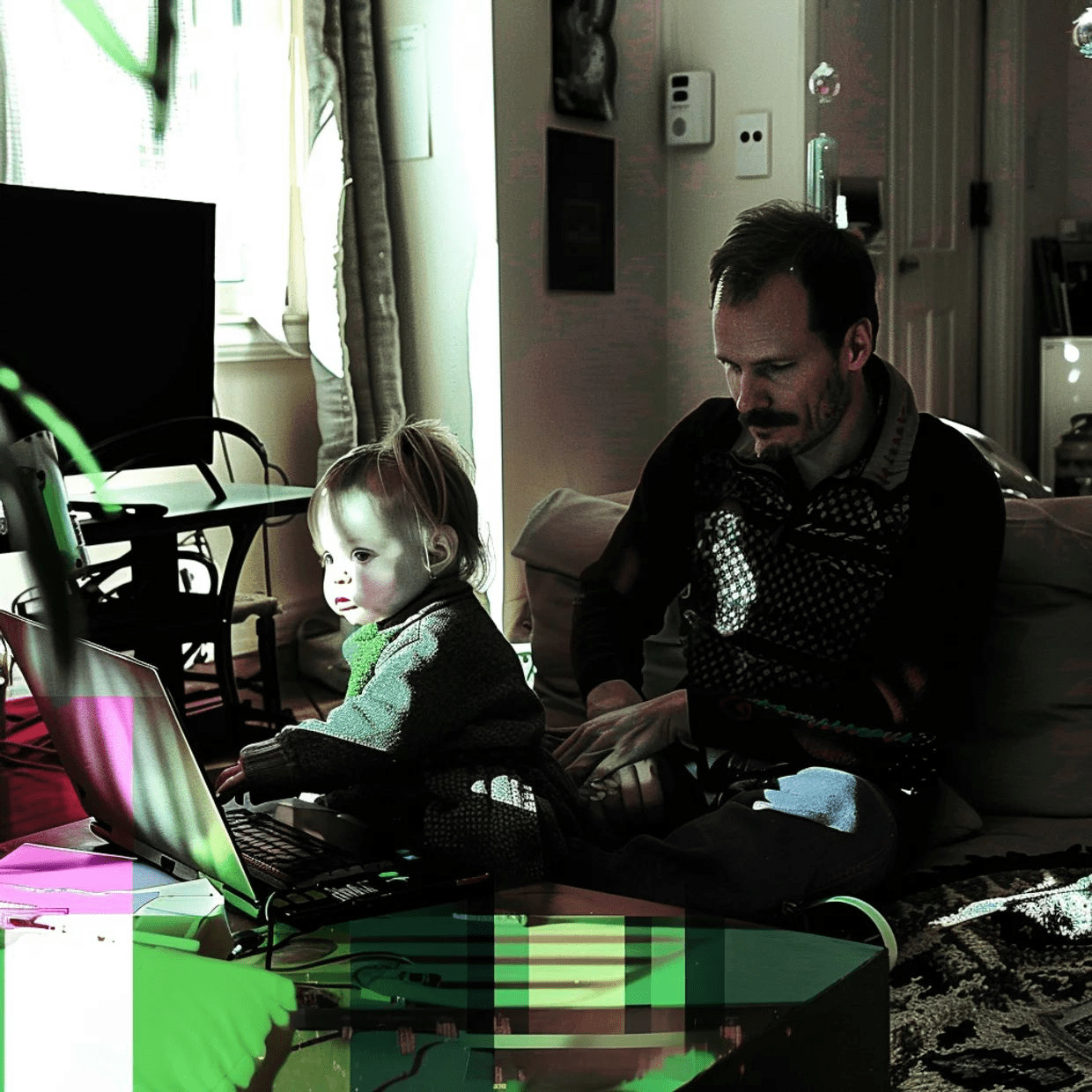
Illustrations by Gabriela Knizkova / Midjourney.
This article is part of “Dads on Parental Leave,” a series of articles published by the Czech magazine Heroine with the support of Transitions’ Solutions Journalism program.
