


The EU’s inadequate response to breaches of its principles has given rise to a new group of frustrated former Polish europhiles – the “eurodisappointed.” From LSE.
According to the V-Dem Institute, Poland, under its Law and Justice government (2015-2023), became the fastest country in the world to backslide into authoritarianism. In response, the EU triggered its “nuclear option,” the Article 7 procedure that allows the EU to sanction member states for violating the EU’s core values.
Yet the fact this procedure relies on unanimity among member states rendered it toothless, with the Polish and Hungarian governments forming a “backsliding coalition” to block sanctions. European Court of Justice judgments on the incompatibility of Polish reforms with EU law, as well as its calls for the immediate suspension of new legislation, also failed to protect the rule of law.
This failure has been explained by the so-called “authoritarian equilibrium.” According to this theory, the weakness of the EU party system protects autocrats from EU interventions, while EU funding and the emigration of dissatisfied citizens made possible by EU free movement help keep these regimes in power.
What is less well understood is the impact of the EU’s inadequate response on individual attitudes toward the EU. Although Polish society stands out as one of the most pro-European within the EU, there has been growing pessimism among some former europhiles in Poland regarding the essence, fundamental values, and implementation of EU procedures by Brussels.
This implementation has been viewed as being hesitant, sluggish, and ineffective in dealing with politicians and governments that clearly violate fundamental EU values, particularly in the domain of the rule of law. The phenomenon is not yet widespread, but the disappointment is already visible and has given rise to a complicated love-hate relationship with the EU that we term “self-limiting euroenthusiasm.”
We now see a new category of individuals who were previously strong supporters of integration but who are now disillusioned with the EU’s slow response to rule-of-law violations. We call this group of individuals the “eurodisappointed.” We argue this phenomenon is distinct from traditional euroskepticism, as the eurodisappointed express neither “contingent or qualified” nor “outright and unqualified opposition to the process of European integration.”
Features of the “Eurodisappointed”
We assume the eurodisappointed are deeply rooted to the general idea of the EU and its core values. However, they temporarily refrain from unconditional appreciation of the EU, mainly – in their view – because of its perceived political malfunctioning. We believe the eurodisappointed consciously “self-limit” their appreciation and future expectations of the EU. Thus, eurodisappointment can be defined as the “self-limitation of enthusiasm for European integration due to the EU’s procedural–political malfunctioning resulting in an inadequate defense of the rule of law and human rights.”
There are two underlying assumptions in this definition. First, only supporters of European integration can belong to the eurodisappointed. Second, eurodisappointment is directly linked to the EU’s sluggish reaction to the dismantling of the rule of law and democratic principles in EU member states.
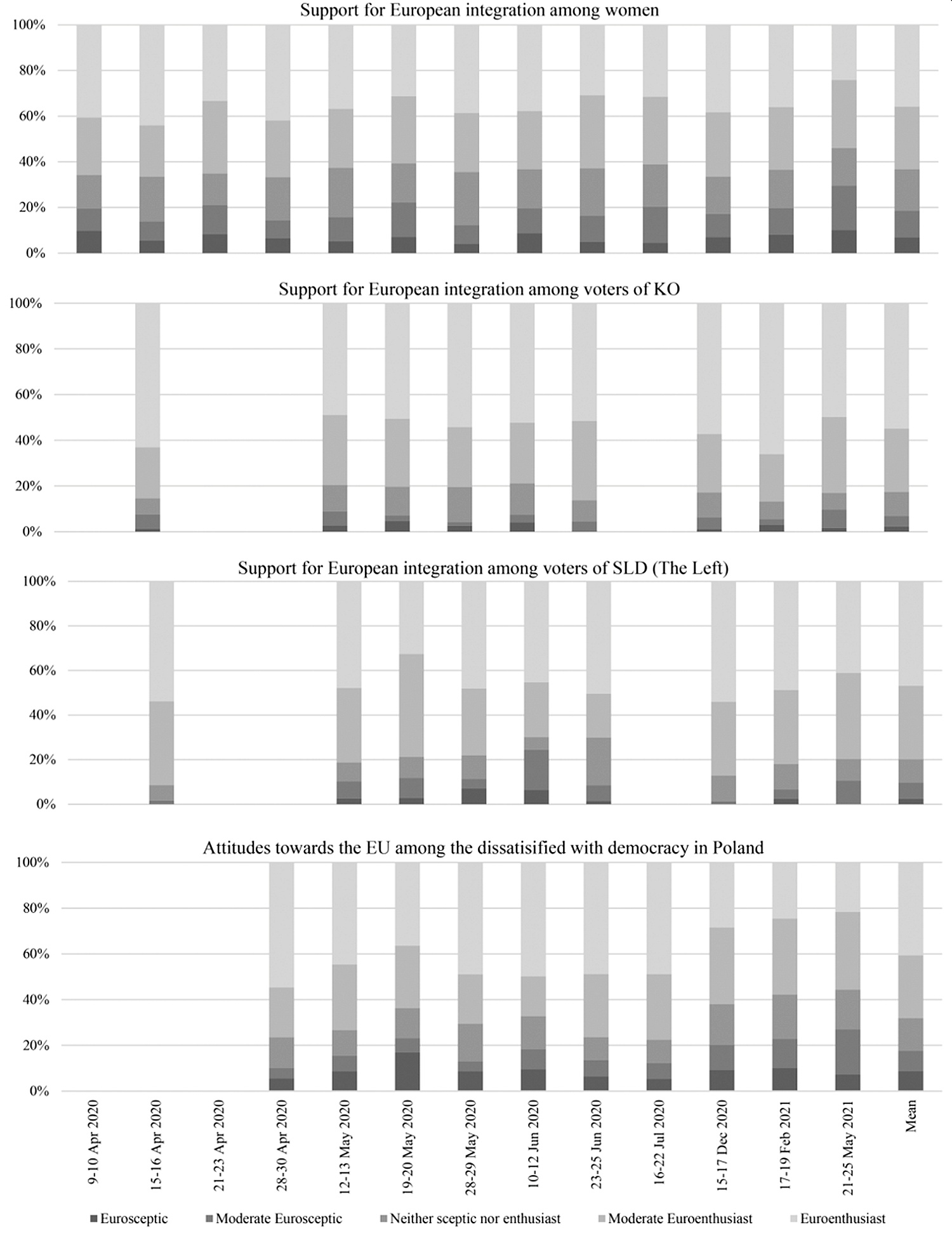
Based on original survey data collected in Poland from April 2020 to May 2021, we find that eurodisappointment is more prevalent among women, supporters of the liberal democratic camp, and those dissatisfied with the functioning of democracy in Poland (see Figure 1). Regarding gender, this phenomenon may be unique to Poland due to the strong anti-abortion stance of the Law and Justice government and a high-profile anti-abortion ruling by the Constitutional Court in October 2020.
Figure 1: Factors explaining eurodisappointment in Poland

We also tentatively suggest that at least part of the recent decline in pro-EU sentiment in Poland can be attributed to a decrease in support for integration among those social profiles most disappointed with the EU’s inadequate response to violations of the rule of law and human rights (see Figure 2).
Figure 2: Evolution of support for European integration by social profile in Poland
We do not claim that this phenomenon is universally present in the EU. Future research is needed to test its prevalence in other countries facing backsliding (Hungary) and the more established democracies of Western Europe. Can, for instance, certain minorities (e.g. LGBTIQ+) concerned with the lack of defense of their rights in other EU countries become eurodisappointed too? For now, eurodisappointment may be a marginal phenomenon affecting specific groups and with limited political impact. However, it could potentially develop into a significant constraint and a challenge for the future of the EU.
…
Radoslaw Markowski is a professor at SWPS University in Poland. Piotr Zagorski is an assistant professor at SWPS University. This article was originally published on the website of EUROPP – European Politics and Policy, a publication of the London School of Economics.
For more information on the authors’ research, see their accompanying paper in European Union Politics.
