


Ukrainian startups are betting on cheap tech to save lives and get the country’s vital farms back in business.
A large agricultural drone copter flies slowly over a snowy field, dragging a metal sensor through the air. Below, on the ground and underground, lie fragments of anti-personnel and anti-tank mines, shells, and other explosives that litter the territory of Ukraine on both sides of the front.
This was a test flight of a new version of the MinesEye demining system, under development by a Ukrainian charitable foundation. Combining data from aerial photography, magnetometers, and infrared cameras, the drone’s task is to locate all potentially dangerous objects. On this April day, the drone found 18% of the 146 explosive devices planted using its cameras. Adding magnetic scanning data to the analysis raises the hit rate to 90% of metal-containing projectiles.
“In any other industry, this would be a success,” says Vlad Kozak, whose Postup Foundation is behind MinesEye, “but here it is a sign of more work to be done.”

Millions at Risk, Billions Pay the Price
That is something of an understatement. The task of demining in Ukraine is staggering: 5 million Ukrainians live in areas that may have been mined at some point during 10 years of fighting. Much of this land used to be fertile fields that made Ukraine a world farming giant. Coupled with Russian destruction of port facilities, taking this farmland out of production is one reason for the global rise in grain and other food prices since 2022, when Russia launched its all-out assault on Ukraine across those very fields.
Making this land safe again will require decades, even by optimistic estimates, at an enormous cost. Even though more than 2,000 military and civilian deminers are deployed now, many more are needed, and special equipment to disarm mines safely is in short supply.
According to estimates by the World Bank, about 10% of the potentially dangerous territory of 144,000 square kilometers is contaminated with explosive objects. This does not mean that the entire territory is littered with mines. Some areas far from the epicenter of the fighting are almost unaffected. But in large areas of eastern and southern Ukraine, on both sides of the front lines, fields are strewn with mines and unexploded ordnance.
As of March, mines and other explosive devices had killed 289 civilians, among them 15 children, a Defense Ministry official announced this past spring. Another 661 people have been injured in such explosions.
Special armored machines are also used, enabling deminers to safely disarm explosives and cover far more ground per day than humans can. But they can cost as much as $1 million each.
The answer to all these problems lies in innovative technology, according to the MinesEye team and dozens of other domestic and foreign tech operations.

Giving the Fields Back to the Farmers
Agriculture is an important part of Ukraine’s economy. Before the Russian invasion, the country exported 10% of the world’s wheat, and was the fourth-largest exporter of corn and the world’s largest supplier of sunflower oil. The subsequent rise in food prices was felt around the world.
According to the Ministry of Economy, 5.6 million hectares of fields have been mined in Ukraine. If they are not returned to use, farmers could lose up to $2.5 billion every year.
Most of the crop is grown in the southern part of the country, which was the most affected by mining and, in part, is still under occupation.
Why Ukraine’s mines are a global issue
- The task is enormous: According to the latest government data, more than 156,000 square kilometers of Ukrainian territory needs to be inspected for mines – an area larger than Greece.
- Mines kill: Nearly 300 civilians have died in incidents involving mines and other explosive devices.
- The cost is high: Demining the entire contaminated territory could cost $37 billion (World Bank estimate) or up to $50 billion (Ukrainian Economy Ministry).
- Cheaper, safer machines are urgently needed: Human deminers can clear just a few dozen square meters a day. Expensive specialized machines can cover from 0.5 to 10 hectares per day – still far too slow.
- Ukraine’s economy and the world’s food security depend on it: Before the invasion, Ukraine was the world’s largest exporter of sunflower oil and fourth-largest exporter of corn, as well as supplying 10% of the world’s wheat. Most of these crops are raised in the south – the region most affected by mining, and still partly under Russian occupation.
To make croplands and other dangerous territory safe again, humanitarian demining is required so that civilians can return home and live safely, as well as sell or use property. Humanitarian demining – as distinct from demining an active conflict zone – starts with a close inspection of the territory to identify potentially dangerous objects, map the area, clear it of mines and unexploded ordnance, and issue a certificate that the area is safe.
The State Emergency Service of Ukraine (SESU) takes a key role in the complex process of demining. Once a contested area is back under Ukrainian control, SESU’s primary task is to restore infrastructure: power lines, gas supply, main roads.
Most of the land is returned to its owners after what is called the non-technical survey – visual inspection of the area using drones and satellite images, interviewing local residents, collecting data from open sources.
According to the law, any territory where the movement of troops took place is considered conditionally mined, and security protocols require the surveying of areas where troops were stationed or where combat operations occurred. During the 18 months after the liberation of the part of Kherson oblast west of the Dnipro River, for instance, 37% of the 6,000-square-kilometer recovered region was surveyed. This was a relatively “easy” job in that the land for the most part was not demined after being surveyed, likely because few or no explosive devices were found. Further to the east and south, the concentration of mines is higher and recovering land for safe use will be a harder task.
The second stage is a technical inspection, when human deminers do a more fine-tuned search of an area using metal detectors. If they give the all clear, the land is considered safe for civilian use.
If mines or other unexploded ordinance are found, they must be removed, either manually or with the use of special vehicles.
The cost increases at each stage. “Checking with satellite images costs less than $1 per hectare. And if the land is contaminated with unexploded shells and landmines, the cost of manual clearing can reach up to $100,000 per hectare,” says Paul Heslop, head of the UNDP Mine Action Program in Ukraine.
In most cases, demining using existing technology typically costs from $5,000 to $20,000 a hectare, a prohibitive amount that leaves farmers praying that no explosives are found on their land. Usually, around two-thirds of the potentially mined territory is declared as suitable for use after a non-technical survey. That, however, still means many farmers cannot work their land.
This is how demining works in relatively safe conditions, on open fields. Other places where mines may lurk are harder to access. And nearer the fighting, the Russian army can re-mine already cleared fields with remote mortar systems. As the war rolls on, the front line shifts constantly, leaving destruction and mines in its wake.
With an enormous swath of territory to check under challenging conditions, it is clear that the task of demining will run on for many years. That demining is far from complete in Croatia and Bosnia three decades after the end of regional conflicts underlines this grim fact.
“There are different opinions about how long it can last. The mass media make headlines with scary numbers about 700, 200, 100 years. Yes, it’s definitely a long process, but the final figure will depend on a lot of factors,” says Valentyn Maidaniuk, co-founder of Soloma Cats, a charity that aids deminers and medical workers, and a member of the National Aviation University’s mine research effort.
Despite the apocalyptic forecasts, the Ukrainian government has set an ambitious goal: to restore 80% of mined areas to use over the next 10 years.
In addition to recruiting more specialists and purchasing special equipment, the government has high hopes for new technological solutions. Either directly or through a series of partner programs, the state sponsors engineering teams and startups working on ways to accelerate demining. Startups with a good idea can receive a grant to finance and develop their idea from a state funding platform. There are also similar initiatives run by the Kyiv School of Economics and a number of other organizations.
Deputy Economy Minister Ihor Bezkaravainyi, who coordinates the ministry’s humanitarian demining projects, has talked about Ukraine as “currently the largest testing ground for the latest technologies.” In an interview with Transitions, he reflected on the current challenges.
“You need to understand that we don’t yet have a magic wand – no technology can guarantee the rapid demining of Ukraine or any other territories,” said Bezkaravainyi, a veteran who himself lost a leg to a mine nine years ago. “Maybe one day we will burn out mines with lasers, but a fundamental change is needed. Something like inventing a new form of gunpowder,” he told Transitions.
Bezkaravainyi revealed that a high-tech demining system is undergoing pilot tests in the Kharkiv region, using satellite sensing technologies. Satellite data is set to be the key to future, safer demining jobs, he said. Photos taken from space can pick up evidence hard for human eyes to gather, such as soil compaction, spilled fuels, or traces of heavy machinery.
Success in the pilot program will see the system brought into use in other parts of Ukraine, he said.

Meanwhile, many Ukrainian and foreign startups are trying to find ways to use drones to detect explosives and speed up searches.
Kozak, an IT executive and founder of the Postup Foundation, says it was the first in Ukraine to master aeromagnetic surveying by drone.
“With the help of aeromagnetic surveying, we can search for iron-containing objects, which can be mines or ammunition, and also do deep scans of the ground,” he says.
The key hurdle facing the system’s developers was the lack of any effective method of attaching a magnetometer to an aerial drone, he explains. Since the magnetometer is a passive sensor, it registers any changes in the magnetic field, including those produced by the aircraft itself.
To skirt this problem, the MinesEye developers designed a drone with the magnetometer trailing two meters or more from the drone body. They also had to tweak the device so the magnetometer would not cause the drone to rock, because this can throw off its measurements.
Kozak says this system not only delivers higher quality results, it also allows the operator to maneuver the sensor and dive into vegetation without the risk of losing the device.
At this early stage, MinesEye has just one prototype drone, which has conducted more than a hundred flights, including test flights in cooperation with SESU, UNDP, and the Ministry of Economy. Its aeromagnetic surveying system is augmented by an orthographic camera that takes five-seven photos per second, or 120,000 photos per hectare, giving a detailed photo map synchronized with other measurement results. In a day, a drone with a magnetometer can scan 20 hectares, or double that if more powerful sensors are used.
The cost of such an installation will probably run around $50,000-$60,000 once full-scale production starts. The Postup Foundation estimates that $500,000 is needed to complete development and set up mass production of MinesEye systems. This is a much higher amount than is given to startups under government acceleration programs, so the team is looking for international donors.
“We are trying to attract institutional financing. For example, we received a NATO ‘Science for Peace and Security’ grant to improve our product and bring it to a higher level. And the second goal is mass production,” Kozak says.
These two goals, both crucial if the system is to go into operation, create a dilemma for the MinesEye team, he continues.
“The longer we do R&D, the longer it will take to mass-produce. But the sooner we start implementing, the worse the product will be.”
The cost of scanning a mined area with MinesEye will be up to $100 per hectare. The system processes data from the magnetometer and creates a map of the field with the precise coordinates of anomalies. These may not necessarily be explosives. But, the developers believe, such maps will simplify and speed up the job of demining, as well as reducing damage to special equipment that can cost hundreds of thousands of dollars.
By helping identify fields with fewer potential explosive devices, the system will also bring economic benefits and increase food security by accelerating the critical task of making fields safe for farming again.
MinesEye promises to make demining huge swaths of Ukrainian territory faster, cheaper, and safer. The system is not perfect, however. One limitation is that there is no current technology for detecting buried mines in plastic casings. Also, the drone is mainly intended for work in open areas. For now, it is impractical for use in forests or towns.
MinesEye operates in a crowded field of tech firms and researchers looking to enhance the use of robotics and AI to help human deminers. Thirty development teams presented their ideas at a “demining boot camp” in December under the auspices of the Economy Ministry, including several systems using drones with various kinds of detectors. According to Bezkaravainyi, these kinds of systems must overcome the challenge of “noise” in real-world conditions, as opposed to laboratory testing.
“In ideal conditions, the sensors can work flawlessly, but in reality, the weather, precipitation, soil type, and geographical location have an effect. … Much also depends on the software that works with the data,” he said.
From the Air to the Ground
MinesEye is a tool for the technical survey phase of demining. After that comes the physical work of removing or defusing mines – demanding and extremely hazardous when done by humans. Here too, Ukrainian startups are working on technological aids.
One development that Valentyn Maidaniuk of Soloma Cats calls very promising is the “Boar,” a robot mine clearance vehicle from Aero Hub, a volunteer organization that supports the development of robotics in Ukraine through crowdfunding.
Vitaliy Bezpalenko, an engineer at Aero Hub, explains that he and his colleagues initially focused on drones. Then, after the liberation of the northern Kyiv region in 2022, deminers told them that their most immediate need was a remote way to detect tripwires and buried anti-personnel mines. The suitcase-sized, armor-plated Boar is invulnerable to anti-personnel explosive devices. On the other hand, due to its low weight, anti-tank mines do not sense its presence.
In half an hour, Bezpalenko says, the Boar can cover the same amount of ground it would take a person three to six hours to check for mines. It destroys anti-personnel mines simply by harmlessly exploding them as it rolls over the buried devices. Aero Hub has built about two dozen Boars at a rate of one or two per month, all currently used by the military.
The Boar is especially effective when used in conjunction with a camera-equipped aerial drone. Even then, human deminers are still called in to disarm devices designed to destroy vehicles, with expensive, factory-made armored demining machines in short supply.
Personnel Shortage
The number of deminers that the country needs is huge and they need to be properly trained.
“Right now we’re really focused on [robots], drones, and other developments, but even in a situation where a machine is working, a person still has to check the result of its work,” says Maidaniuk.
At National Aviation University, one of Ukraine’s leading technology institutions, Maidaniuk works with outside partners on the development of demining equipment. The university offers development teams and startups special expertise and facilities, such as a wind tunnel where drone prototypes are tested.
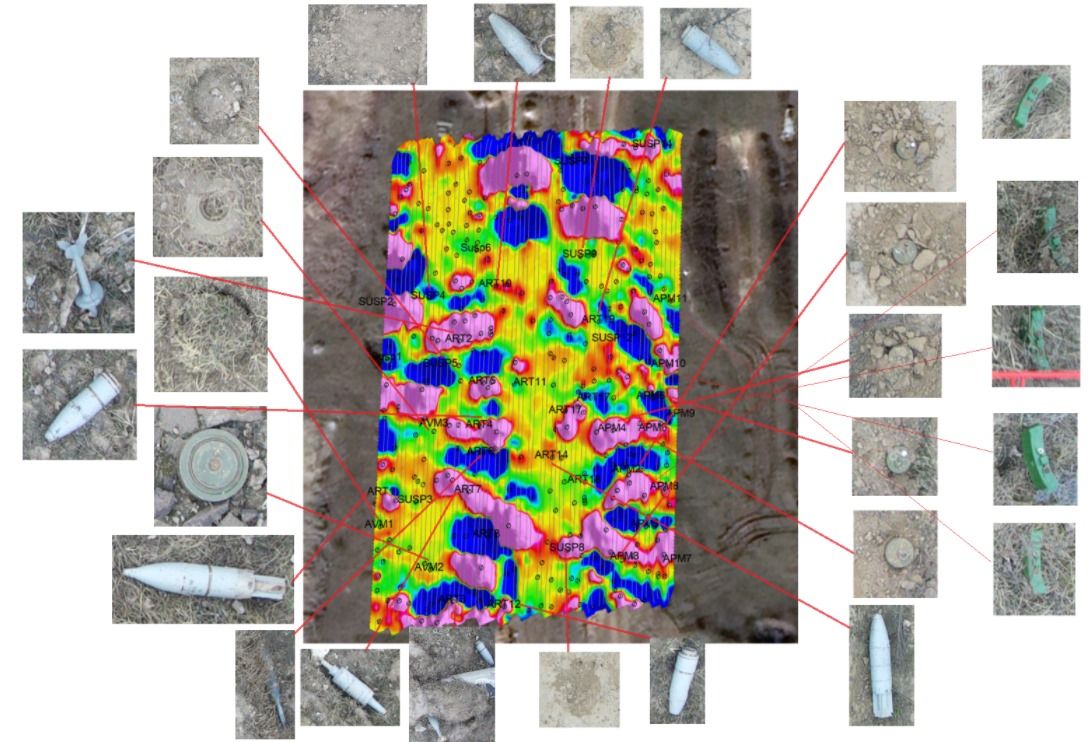
The MinesEye with its cameras and magnetic sensor can pinpoint the locations of buried mines, shells, and other potentially dangerous objects. Courtesy of Postup Foundation.
Currently, about 2,000 deminers work in SESU and in the National Police and National Guard. This excludes military sappers in the ranks of the armed forces. There are plans to increase the number of humanitarian deminers to 2,800. SESU’s civilian demining teams currently have the use of 40 mechanized demining machines, 15 robot deminers, more than 120 unmanned aerial vehicles, 20 underwater drones, and five, small, remote-controlled catamarans. The military is responsible for detecting and disarming seaborne mines. Equipment is constantly being purchased, but not at the pace necessary for the scale of work.
In addition to the state, international and domestic demining operators are involved, both in the public and private sectors.A mine action operator must go through a complex certification process to be allowed to clear mines. At the beginning of the full-scale invasion, four operators were certified. Today there are 40, and another 50 are awaiting certification.
Together, these operators are currently using 109 demining machines – 23 belonging to private firms, the rest to various government bodies – compared to none at the beginning of 2023, according to Economy Minister and Deputy Prime Minister Yulia Svyrydenko.
This year, deminers have inspected almost 172,000 hectares of agricultural land, in addition to about 205,000 hectares last year. In all, about 156,000 hectares have been returned to farmers, according to the ministry.
The Long Road Ahead
Demining over the decades to come will cost several tens of billions of dollars, according to the World Bank and the Economy Ministry. Calculations by the Kyiv School of Economics arrived at a similar figure, estimating the cost of surveying and clearing mines at almost $35,000 per hectare.
Until now, international NGOs and organizations have delivered the bulk of the funding for demining – yet the approximately $300 million earmarked for this purpose by Western countries is a fraction of the billions that will be needed going forward, experts say.
In addition, a USAID-coordinated program to increase Ukrainian agriculture exports has an investment target of $850 million.
The United States contributes funds for demining through organizations including the Danish Refugee Council, HALO Trust, Mines Advisory Group, and the Swiss Foundation for Mine Action (FSD), which works in partnership with the UN Food and Agriculture Organization and the World Food Program to survey and clear small farms.
UNDP is also involved in demining, raising funds from the EU and the governments of Denmark, Sweden, and Japan to supply 202 SESU demining units.
This aid, welcome though it is, is just a tiny fraction of what will be needed. Few farmers, families or agribusinesses alike, will be able to finance demining of their fields from their own resources. International aid will continue to be important, but domestic financing is also required. Here, too, innovative ideas are being trialed, starting with the just-launched “demining market” under the auspices of the Economy Ministry. Landowners who enter into a contract with either a state or private demining operator through a transparent tender are eligible to be compensated by the state for 80% of the cost. The government has allocated 3 billion hryvnia ($73 million) for the program.
The program focuses on humanitarian demining, defined as clearing agricultural and other land lying more than 20 kilometers from the “contact line” between Ukrainian and Russian forces.
The initial budget money is seen as seed funding for what the government hopes will soon be a public-private marketplace matching owners of unsafe land with mine clearance operators.
Five companies have cleared land at their own expense and will soon receive 80 percent compensation. Another 60 applications are under consideration.
Depending on the progress of the many high-tech projects currently in the test stage, farmers may soon be signing contracts for MinesEye copters, “Boars,” and other Ukrainian-made devices to come work on their fields, helping to save lives and revive the country’s devastated economy.
…
Oleksandr Tartachnyi covers IT, military technology, and other topics for the Ukrainian tech news site Speka.media. He previously worked with other science and tech sites in Ukraine and wrote on corruption in public bodies and the Russian invasion for NGL.media.
