


Ever since the tuneful uprising that led to independence, traditional music has thrived as young people embrace and celebrate their heritage.
The third day of July marked a milestone for 25-year-old Lithuanian dancer Egle Rudyte. That evening, she took the stage in picturesque Kalnai Park in Vilnius, the capital of Lithuania, with hundreds of dancers, singers, and musicians from across the country. Dressed in traditional clothes with embroidered geometric patterns of different colors and styles, artists were taking turns in the open-air amphitheater, nested among the park’s trees and the city’s nocturnal skyline. Their skillful performances elicited cheers, applause, and harmonious sing-alongs from the captivated audience.
The event was one of the highlights of the Song Celebration, a cornerstone of this year’s cultural calendar in Lithuania. It was also Egle’s last performance with the prestigious Vilnius University Song and Dance Ensemble after seven years as a member. She stepped aside to make way for younger dancers, but her passion for Lithuania’s musical heritage doesn’t stop there.
“Dances are my identity, my way to express love for my country and preserve our culture and national heritage,” Egle says.
Many young Lithuanians share her passion for their country’s musical traditions. They actively participate in folk music groups, engaging in dance, song, and playing traditional instruments in preparation for public performances in Lithuania and abroad. For some people, like Egle, this deeply ingrained passion for Lithuanian music stems from her upbringing in a folk-singing family. Others fall in love with their musical heritage through extracurricular school groups or mass media. Traditional music serves as a vital part of their cultural identity, motivating them to preserve their heritage.
“The traditional dance community is so unique. It’s great to be a part of it, to share that love for national art, and to organize events like the Song Celebration together,” Egle adds.
The Lithuanian Song Celebration, held since 1924, aims to keep folk traditions alive and preserve the country’s cultural heritage. The festival is considered a unique manifestation of national culture and a symbol of unity and strength. Similar events in Estonia and Latvia date back to the 18th century. They unite thousands of dancers, singers, and musicians, both from amateur and professional dance and choir groups whose musical repertoires span the wide range of Baltic musical traditions, encompassing ancient folk songs to contemporary compositions.

After they gained independence from Russia following the First World War, the celebrations in Lithuania, Latvia, and Estonia won widespread popularity as a means of asserting Baltic cultural identities. However, when the Soviet Union occupied the Baltic countries at the end of World War II, these celebrations were forcefully adapted to align with the prevailing communist ideology.
During Soviet rule, local cultures, languages, and customs were suppressed. Since becoming independent once again in the 1990s, all three Baltic States have undertaken many measures to celebrate and protect this heritage. Since 2008, these song and dance celebrations have been inscribed on UNESCO’s list of the Intangible Cultural Heritage of Humanity.
This July, the Lithuanian Song Celebration celebrated its 100th anniversary. Egle was among 37,000 dancers, singers, and musicians gathered at this year’s Festival, half of them children and youth. Among 300 volunteers at the festival, more than half were young people.
Alongside the Song Celebration, the Lithuanian capital this summer hosted the Baltica International Folklore Festival, an annual folk music event rotating among the Baltic states. This festival saw a large number of young participants as well.
Just days before, Lithuania celebrated Midsummer Day, an ancient pagan festival marking the longest day of the year with bonfires and traditional folk music.
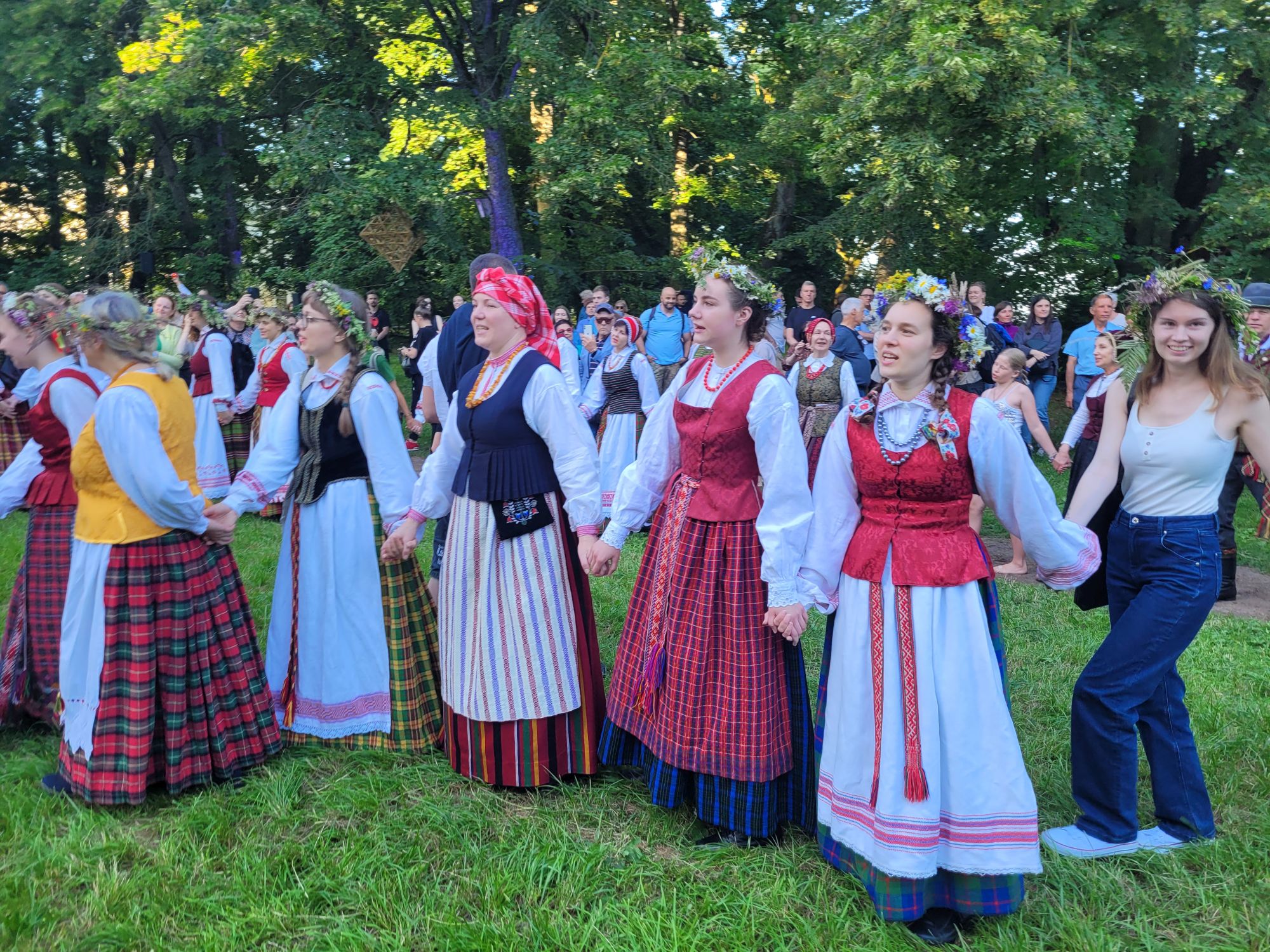
Indeed, visiting Vilnius this summer felt like stepping into a time machine, traversing different points in Lithuanian history. The otherwise quiet city burst with joy and energy.
The squares and parks filled with young, smiling people adorned in traditional costumes and flower crowns, singing and dancing to ancient songs, made it feel like time had gone back a couple of centuries. Seeing thousands of united voices and bodies perform together was both mesmerizing and deeply moving. The feeling of community and belonging was palpable both on stage and in the audience, and it evoked strong emotions even among foreign visitors.
The sights and sounds of Vilnius this summer echo the events in the very same parks and corners when a previous generation launched the “Singing Revolution.” The independence movements in the 1980s across all three Baltic countries featured impressive mass rallies made memorable by spontaneous outbursts of song.
Witnessing hundreds of people singing and performing traditional dances in Vilnius today inevitably brings to mind the famous Baltic Way, when an estimated two million Lithuanians, Latvians, and Estonians formed a 600-kilometer “human chain” across their countries in a peaceful demonstration for independence.
Back then, they used music to call for independence; today, they celebrate it with equal – or even greater – fervor.
“The revolution was not made, fought, organized, or else. The revolution was ‘played,’” musicologist and professor at Kaunas University of Technology Dario Martinelli points out in his paper “The Lithuanian Singing Revolution as Cultural Heritage and Source of Soft Power,” referring to the title of Giedre Zickyte’s 2011 documentary about the Singing Revolution.
The film tells the story of the pivotal role of music in the fight for independence in Lithuania. Like other Baltic states, Lithuania saw spontaneous outbursts of old national songs and the composition of new ones with topical lyrics. The Rock March was one such manifestation of new music. Held from 1987 to 1989 and again in the mid-1990s after independence, the Rock March was a road show around Lithuania’s main cities, featuring performances by pop bands.
“Few other strategies could have been as powerful as this one, once we compare a 3-million-people country against a country 260 times bigger and 50 times more populated,” Martinelli wrote.
Vilnius-based musician and producer Victor Diawara, who created the soundtrack for Zickyte’s documentary, grew up surrounded by Lithuanian folk music. Despite this early exposure, he admits that his genuine appreciation for traditional Lithuanian music has only developed recently, as his initial interests lay in rock and modern sounds.
During the COVID-19 pandemic, when he had a lot of time, Diawara started researching sutartine – polyphonic songs traditionally performed by female singers in northeastern Lithuania. This Baltic musical form is also included on UNESCO’s intangible cultural heritage list.
Together with folk music researcher and singer Laurita Peleniute, Diawara formed a traditional/electronic duo they named Elektronines Sutartines.
“I wanted to make it more appealing to younger generations who don’t think traditional music is cool,” Diawara says.
Many Lithuanian musicians mix all sorts of music styles with folk music, ranging from electro beats to heavy metal riffs, in what is known as “post-folk music,” to explore, cherish, and popularize traditional music. The Folk Music Museum in Kaunas, Lithuania’s second-largest city, showcases dozens of contemporary musicians who mix different genres with folk music elements.
Popular folk-rock band Zalvarinis layers classic rock over the traditionally-styled vocals by its two female singers. Folk Trio weaves Lithuanian folklore together with world and jazz musical styles. Yorigeo, a neo-folk duo, reworks Lithuanian traditional music in pop arrangements.

All of them perform in Lithuania and abroad, presenting traditional music to the Lithuanian diaspora and foreign audiences.
Traditional sounds have even found a welcome among the headbangers. The heavy metal festival Kilkim Zaibu puts on demonstrations of ancient Baltic crafts and folk music and dances alongside black metal and goth groups that lure local and foreign fans.
Adding a notable boost to Lithuanian music’s global presence was the 2023 Lithuanian entry for the Eurovision Song Contest, “Stay (Ciuto tuto)” by young Lithuanian musician Monika Linkyte. Featuring elements of sutartine, the song has sparked interest in Lithuanian cultural heritage beyond the country’s borders.
Folk music festivals like the Song Celebration are drawing increasing numbers of tourists from around the world.
“I think it helps them feel and understand what it means to be Lithuanian on a deeper level,” says Ieva Krivickaite, head of the regional culture department of the state-funded Lithuanian National Cultural Center, which organizes the Song Celebration. “The feedback is usually overwhelmingly positive. Since the Song Celebration is quite a unique event, people will have usually never seen anything like it.”
Similarly, Alfredo Gagliardi from Italy, who visited Vilnius this July at the peak of the folk festival season, was pleasantly surprised by the city’s vibrant atmosphere. He enjoyed the dance performances, which reminded him of traditional dances from Sardinia and southern Italy. While there are folklore festivals where each region showcases its music, such large-scale events do not exist in Italy.
“There’s a much greater sense of national unity in Lithuania, I believe,” he says. “And I was lucky to see that part of its culture and learn more about it.”
…
Lidija Pisker is a journalist and researcher from Bosnia and Herzegovina. Her work has appeared in The Guardian, openDemocracy, Euronews, Equal Times, the BBC, and elsewhere.
Photos by the author.

The publication of this article is part of PERSPECTIVES – the new label for independent, constructive, multiperspective journalism. PERSPECTIVES is being implemented by seven editorial teams from Central and Eastern Europe under the leadership of the Goethe Institute. The author of this article participates in the PERSPECTIVES Journalists-in-Residence Program at the Goethe Institute Lithuania.
