


The Kremlin’s takes on the Ukraine war, NATO, and Bosnia’s EU bid resonate loudly among Bosnian Serbs.
Back in November 2023, a Bosnian journalist at a press conference asked Russian President Vladimir Putin why there were no Russian media in the country’s Republika Srpska entity. Putin responded that he would ask his people to see what could be done. A day later, Russia Today (RT) editor-in-chief Margarita Simonyan said RT’s television channel would soon start broadcasting in Republika Srpska and across the country. (The state comprises two autonomous entities: the Federation of Bosnia and Herzegovina and Republika Srpska, and a third unit, the Brcko District).
While red tape and Bosnia’s tangled internal politics might prevent that from happening, the announcement by the state-owned Russian media company once again put Russian influence on the media space in Bosnia under the spotlight.
RT established a Balkan base in November 2022 when it launched a Serbian-language service out of Belgrade. The international edition of RT has been under EU sanctions since the full-scale Russian invasion of Ukraine and from June 2023, RT Balkan was added to the list of sanctioned media.
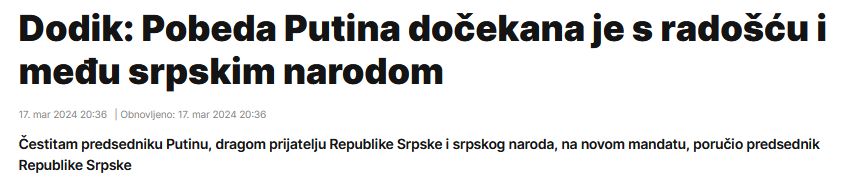
“The victory of President Putin was greeted with joy among the Serbian people,” announces this RT Balkan headline. The quote and almost the entire article text are taken from Dodik’s congratulatory X message to Vladimir Putin. The Serbs admire the freshly reelected Russian leader, he gushed, “because they see in him a great statesman and a friend who we can always rely on and who cares about our people.”
RT is not the only Russian state-owned media outlet operating in the Western Balkan region. The Sputnik news agency, also under Simonyan’s editorial leadership, operates the Sputnik Serbia news portal, which like RT is fully supportive of Putin and Russia’s war in Ukraine. The pro-Russian narrative in Bosnia and Herzegovina (BiH) is not new and has been there for years. Countless examples show that the Kremlin has long favored the ruling structures in Republika Srpska, led by the entity’s current president, Milorad Dodik. Analyses by fact-checking groups suggest Russian influence on Bosnian media, especially in Republika Srpska, has only strengthened since the war began two years ago.
A Cross-Border Bromance
RT Balkan also leans heavily toward Serbian narratives on the Bosnian War, publishing what the Bosnian fact-checking group Raskrinkavanje regards as incorrect statements about the Srebrenica genocide in 1995 and the shelling of Sarajevo’s Markale market in 1994. An analysis of RT’s Balkan content from November 2022 to January 2024 also found numerous misleading or factually incorrect statements about the Ukraine war.
RT Balkan publishes news related to BiH on a daily basis, very often focusing on the activities of Republika Srpska’s president, Milorad Dodik, one of Russia’s most outspoken defenders in the Balkans and a frequent interviewee on Russian media. The site’s search engine displays more than 100 articles mentioning Dodik in January 2024 alone, and 96 more in February.
These reports were mainly positive, mentioning among other things, Dodik’s views on the High Representative in BiH, the Constitutional Court of BiH, the controversial celebration of the Serb republic’s holiday on 9 January, and also his antagonism toward the United States and support for Russia.
Is RT coming to the Bosnian airwaves?
As of early February, RT had not applied to the BiH Communications Regulatory Agency for a broadcasting license, local media reported. A source at the agency said unofficially that because RT’s international services are under sanction in the EU, the agency would request the opinion of the tripartite Serb-Bosniak-Croatian Bosnian presidency if RT applied for a license.
BiH “has fully complied with the EU’s foreign policy, including decisions on restrictive measures,” EU spokesman Peter Stano told RFE/RL in January, going on to say that such measures must be applied throughout the country, “including the Republika Srpska entity.”
In an interview Dodik gave RT in late January, he threw his support behind the Russian invasion of Ukraine, and described Putin as conveying a “humane political approach.”
“It was very difficult for Russia to defend the interests of our side [Republika Srpska] in international forums, and now it is time to show our commitment to partnership. Despite the fact that the West, abusing its undoubted political power and sometimes resorting to brute force, tried to force all countries to condemn Russia and impose sanctions against it, on behalf of Republika Srpska we said that this would not happen and we did not allow Bosnia and Herzegovina to join the restrictions,” Dodik stated.
He also wished Putin luck in the March presidential elections in Russia and the maximum support of the people, returning the favor Putin bestowed ahead of Dodik’s successful run for the Republika Srpska presidency in October 2022.

Republika Srpska state broadcaster RTRS’s coverage of Putin’s reelection on 19 March cites Latvian-Russian Ruslan Pankratov saying, “The West failed to disrupt the presidential elections in Russia” and Serb-American commentator Srdja Trifkovic’s view that “The Russian people are united around Putin’s stable and steady state policy.”
Dodik the Decolonialist
Dodik also dominates Sputnik Serbia’s reporting on the Bosnian political scene.
The 2022 Bosnian election campaign saw no noticeable spread of disinformation about the elections by Sputnik Serbia, but there was obvious bias and a preference for Dodik and his ruling SNSD party in Republika Srpska. The site’s search engine yielded 163 hits to a search on “Dodik” limited to September and October 2022, and a mere 38 hits for the losing presidential candidate, Jelena Trivic of the Party of Democratic Progress. There were stories on Dodik’s visit to Moscow to meet Putin midway through the campaign, and analyses of his strong chances of winning the entity presidency and the outlook for other SNSD candidates in the other levels of government.
A review of this content finds that Sputnik Serbia’s coverage largely coincided with the main political narratives presented by Dodik and other SNSD officials. Favorable stories cited Dodik’s claims that BiH will never enter NATO and that sanctions on Russia hurt the EU more than Moscow, as well as his enthusiasm over the September 2022 referendums when residents of four Russia-controlled regions in Ukraine purportedly voted overwhelmingly in favor of joining the Russian Federation, and his contention that Bosnia must rid itself of its “colonial status.”
The election outcome surprised almost no one, as Dodik was elected president of the entity for the third time, while his party secured a third of the vote in the entity assembly elections, far outpacing its rivals. The SNSD – led by Dodik since its founding in 1996 – has won more votes than any other party and been a governing coalition member at every election in Republika Srpska since 2006.
Sputnik paid much less attention to the opposition in Republika Srpska. Only a handful of articles reported on the announcements of the Party of Democratic Progress and the other main opposition force, the Serbian Democratic Party,while some of the content relating to Trivic emphasized Dodik’s negative comments about his rival, or took the form of commentary casting a positive light on SNSD candidates.
This heavily imbalanced coverage mirrored Sputnik Serbia’s reporting on previous Bosnian elections, including local elections in 2016. As in 2022, the portal devoted far more space to Dodik than to his opponents the last time he won the Republika Srpska presidency, in 2018.
Despite attracting far fewer site visits than locally owned news outlets, content from RT Balkan and Sputnik Serbia is often repeated by pro-Dodik Bosnian media such as the public broadcaster RTRS and the SRNA agency.
Hitting the Same Note
The media space in Bosnia cannot be understood in isolation from the regional context, since practically the same language is spoken in Serbia, Croatia, and Montenegro, and many TV channels are watched in all these countries, not to mention social media and websites.
Reporting on the war in Ukraine provides a prime example of how misleading or false information and narratives can spread across the region.
SEE Check, a consortium of five regional fact-checking organizations (Raskrinkavanje.ba, Raskrikavanje.rs, Fakenews.rs, Raskrinkavanje.me, and Faktograf.hr), analyzed news reporting on the first 150 days of the war.
Their study flagged almost 1,400 articles and social media posts with “manipulative or inaccurate” information on the war during the period, most of which the study attributed to “Russian propaganda that has found its way into the countries of Southeast Europe.” Pro-Russia narratives far outnumbered reports praising Ukraine in an unbalanced fashion, the authors wrote.

Serbian media were the most common source of misinformation, the analysis found. The authors identified the most prevalent narratives of the war as justifying the Russian invasion by accusing Ukraine of Nazism, possession of biological, chemical, and nuclear weapons, and planned attacks on Russia; accusing NATO of planning to attack Russia; using the approved Kremlin vocabulary to refer to the invasion as a “special operation” or “counteroffensive”; and glorification of Russia, Putin, and the Russian army.
Pro-Russian content is present in the media in the RS on a daily basis, even without being promoted by Russian media. Thus, the views of the Russian ambassador on political issues in BiH or speeches by Putin and other Russian officials can often be read on the RTRS website. After the Russian president called the invasion a “special military operation,” outlets such as RTRS, Alternativna televizija, Nezavisne novine, Glas Srpske and others started disseminating the same narrative.
The influence Russian media has on public discourse in Bosnia is open to debate, particularly in Republika Srpska, where Kremlin-friendly views on many things, not least the war in Ukraine, are daily fodder in most media and across the political spectrum, despite the huge antagonism between the government and the opposition.
Public opinion on the war is deeply divided in the Federation entity, where the Bosniak and Croatian communities share power and Serbs are a small minority. Here, media typically use the terms “war,” “invasion,” or “Russian aggression.”
Bosnia was invited into NATO’s pre-accession MAP scheme in 2010 and was recognized as an official candidate for EU entry in 2022, after years of hard bargaining. But the Serb entity’s longstanding suspicion of Western institutions, marked by Dodik’s frequent denunciations of NATO and his occasional talk of seceding from BiH, continues to stymie the country’s negotiations on joining the Atlantic alliance and the European Union, which declared Bosnia a candidate country in December 2022. Recent visits by top brass of both organizations underscored the many difficulties that still remain, nearly 30 years after the Dayton Peace Agreement, signed in 1995 to end the Bosnian War, which killed an estimated 100,000 people and displaced over 2 million.
Resistance from Dodik, then, goes against official policy as set in Sarajevo. Nevertheless, this kind of activity is by no means negligible and thanks in part to constant repetition by local and Russian media, it creates pressure on the already complicated political scene in the country. In this election year both in BiH and the EU, RT’s declaration of intent to start working in Republika Srpska means that Russian media influence in the country is not waning, just as it is not declining politically through actors like Dodik.
…
Dalio Sijah has worked since 2011 for Zasto ne? (Why not?), a Sarajevo-based civil society organization that works for greater accountability and transparency of government, where he is chief editor of the political accountability monitoring project Istinomjer.
