


In Bohemia’s rolling fields, Wenzel Lobkowicz swapped plows for pastures and discovered that giving animals freedom might also give the soil new life. From Ekonews.
Wenzel Lobkowicz has been farming in Drahenice, on the border of Central and South Bohemia, since 2017. He started with black Aberdeen Angus cattle; today he also grows various grains and, in an unconventional way, raises pigs. Why unconventional? Because they roam freely. All of this happens on nearly 200 hectares of land.
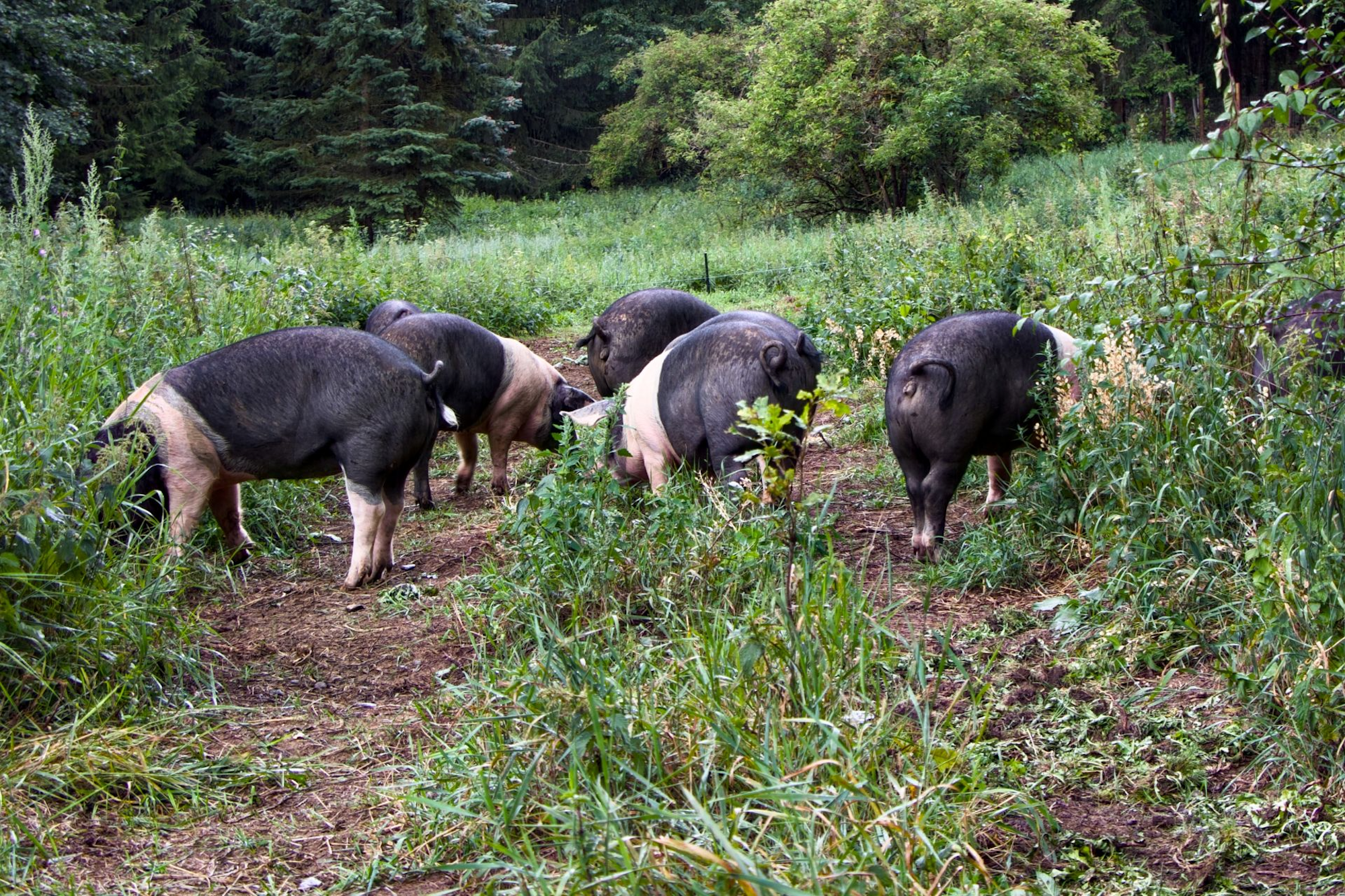
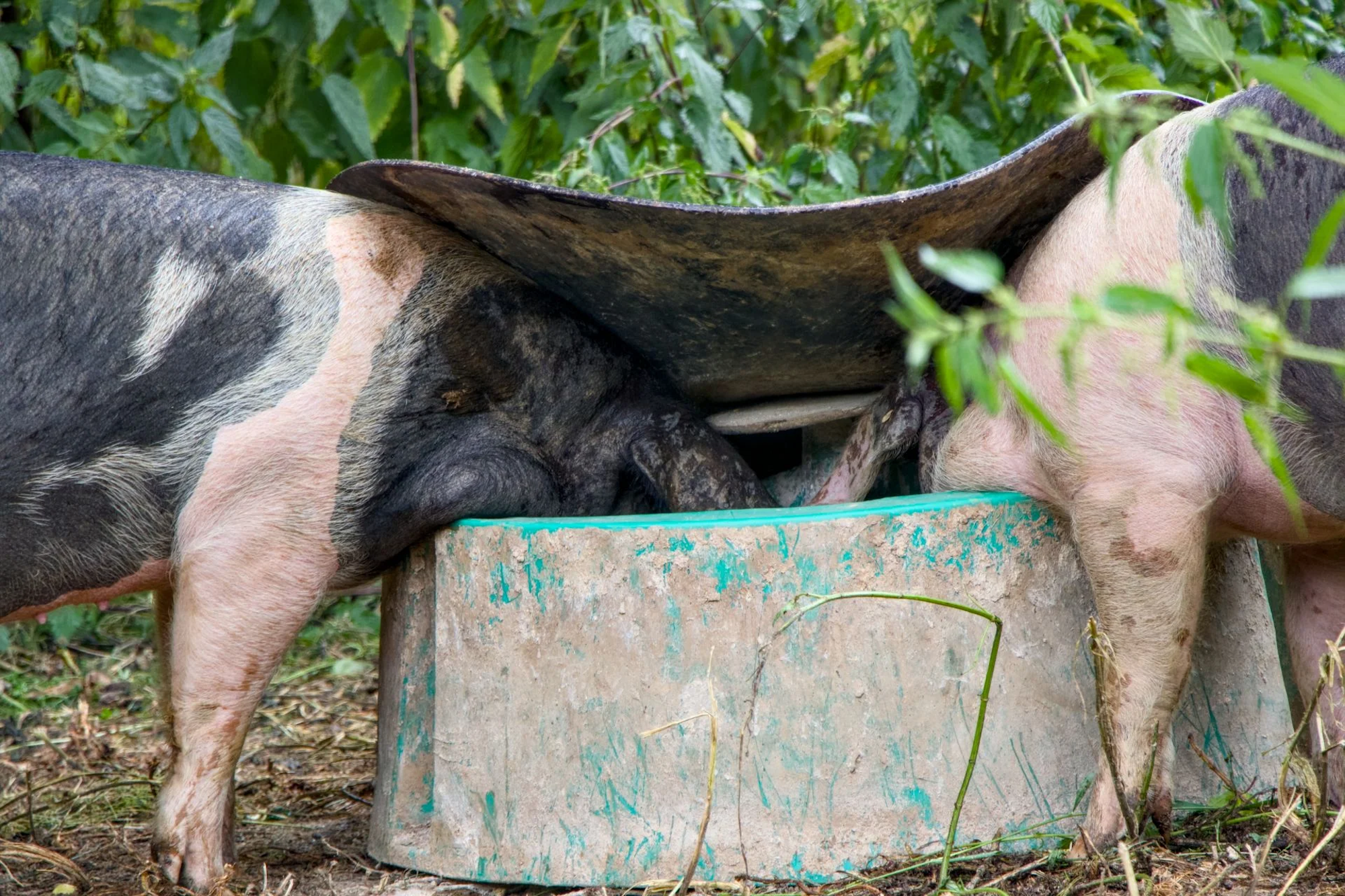
On a rainy July day, we reach the pigs’ pasture by passing through two gates. When called, the piglets emerge from behind the trees and run toward us, sniffing curiously to see whether we’ve brought anything to eat.
When one of the pigs realizes I have nothing, it gives my knee a disappointed nip. “They’re used to people because we move them regularly,” explains Lobkowicz as he shoos the piglet away with his hand. “We got them at Easter. So far we have 20 and we’re testing whether it pays off and whether they’ll live well here,” he says, showing me photos of piglets on his phone.

Reseeding Every Five Years Doesn’t Make Sense
His branch of the aristocratic Lobkowicz family has been involved in agriculture in Drahenice for many years. After returning to the Czech Republic in the 1990s, they began tending the local forests and fields alongside keeping up the chateau whose ownership reverted to the family with the fall of the communist regime. On these lands they developed ecological forestry based on mimicking natural processes.
When Wenzel Lobkowicz took over the pastures from the last tenants in 2017, they were, he says, in very poor condition. The soil was packed down, weeds dominated, and the yields could not sustain a herd.
“An expert advised me to plow, sow, and repeat it all every five years, which would cost a lot of money and struck me as illogical. Nature has been here for thousands of years – why should I change it?” he recalls.
So he decided to look for another solution. Online he came across an American farmer named Joel Salatin, who has practiced regenerative agriculture for decades. Salatin insists that the way to raise low yields with minimal cost is by managed movement and rotation of animals.
“You can’t be intimidated by not having all the answers at the beginning. In 2017, all I knew was that I wanted to have cows and calves in a pasture,” laughs Lobkowicz. “Maybe it would have helped if I had read four more books, but I would never have decided to start.”
To learn how to put regenerative grazing into practice, Lobkowicz took a course from Salatin. “The big advantage for me was that I was starting from scratch. I had no idea how things had been done in the past, and I was willing to try new things,” he adds.
He says it’s important to experiment, and regenerative methods can be tried out gradually. Each year, Lobkowicz introduces three new methods and sticks with only those that work. He looks for inspiration from other farmers, taking something from each.
Regenerative Grazing Saves Feed
Lobkowicz started regenerative grazing in Drahenice in 2019. In practice, this means that smaller herds move between defined pieces of pasture every day. This gives the vegetation more time to regenerate.
Every farmer approaches grazing differently. The movement of animals between meadows is common, but it usually occurs after 20 or more days. The difference also lies in how much of the year the animals are in the pasture.
The yield of meadows is important, and it varies from region to region. It is affected by soil properties, erosion, and weather. When the pastures do not provide enough food for the animals, they need to be fed, which makes farming more expensive.
The regenerative method of grazing imitates the movement of wild herds and allows the grass to grow, and its roots to strengthen, improving the condition of the soil. Thanks to a richer root system, more organic matter, and thus carbon, is stored in it.
Less Than 1 Percent Nationwide
Most Czech cattle and pigs are raised indoors in halls. Grazing is mainly the domain of small, usually organic farms where this approach predominates.
According to the Czech Statistical Office, the country has about 900,000 hectares of permanent grasslands, including pastures and meadows. Their importance has grown in recent decades, largely thanks to beef cattle farming.
Although only 17 percent of Czech farmland is managed organically, nearly half of the country’s permanent grasslands fall under organic management. Organic farmers raise just under 200,000 cows, while conventional farms manage around 1.2 million more.
Exact figures for how many Czech farmers practice regenerative grazing don’t exist. The Platform for Regenerative Agriculture estimates that around 30,000 hectares – less than 1 percent of all agricultural land – are managed this way, including fields used for pasture and for crops.
The Difference Is Obvious at First Glance
Together with Wenzel Lobkowicz and his two golden retrievers, we leave the pigs and head to another organic pasture, this time just outside the village. We descend a narrow, winding road to the meadow where the cows graze.
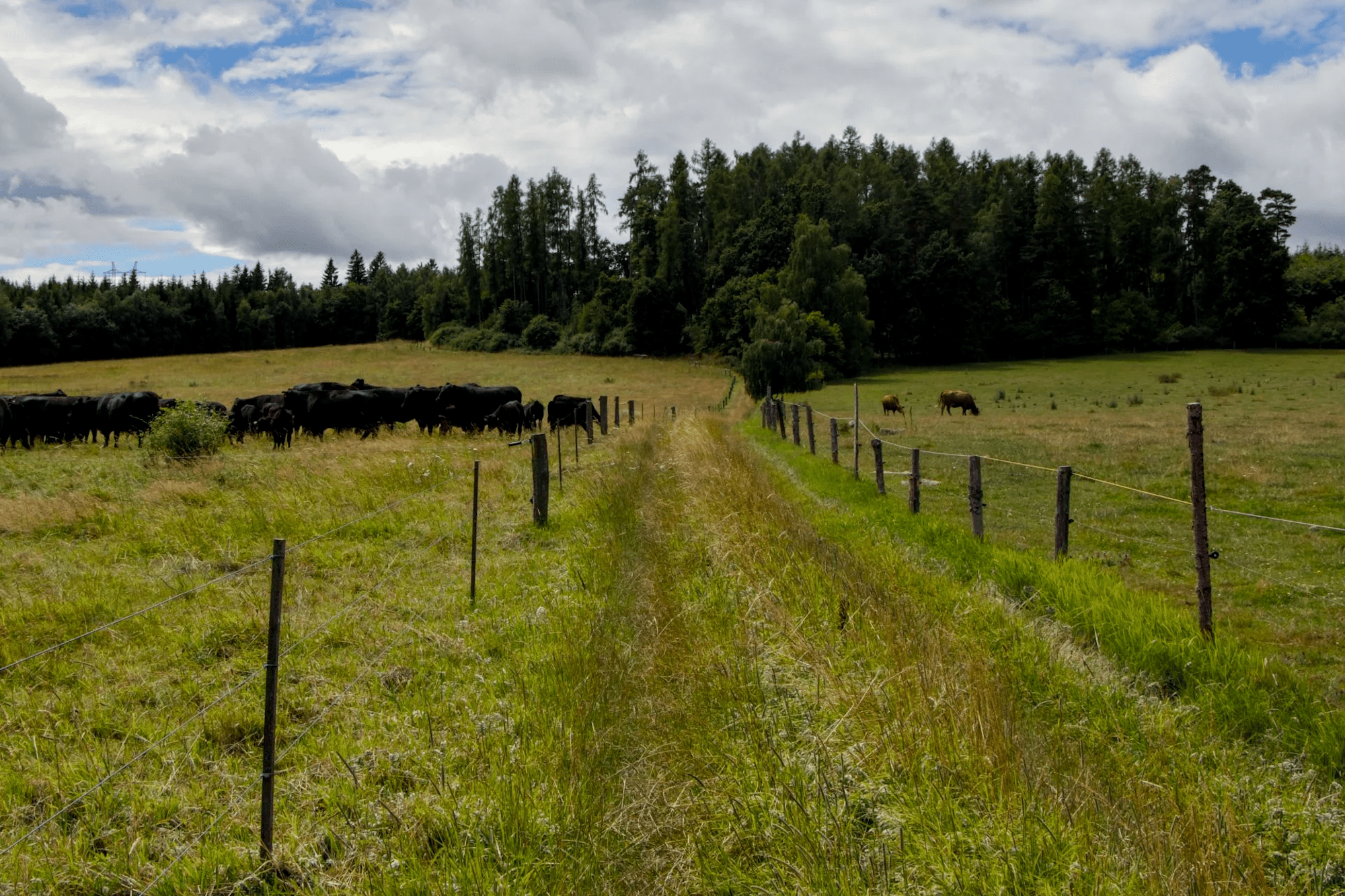
Lobkowicz’s pasture is separated from his neighbor’s land only by a narrow dirt path, yet the difference is striking: his field is taller and more diverse, filled with many kinds of grasses and low shrubs that form a varied mix, while the neighbor’s is short, dense, and uniform.
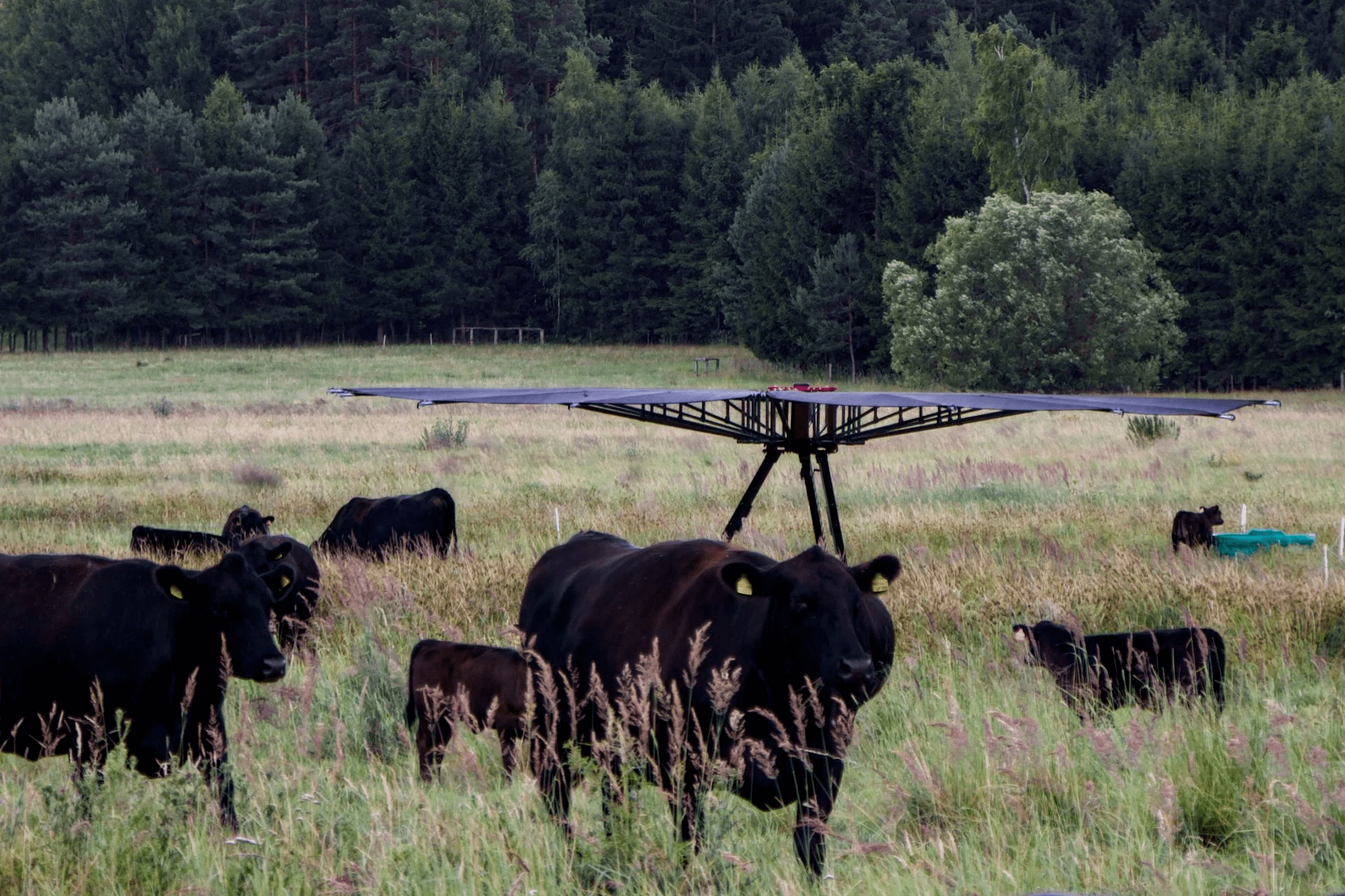
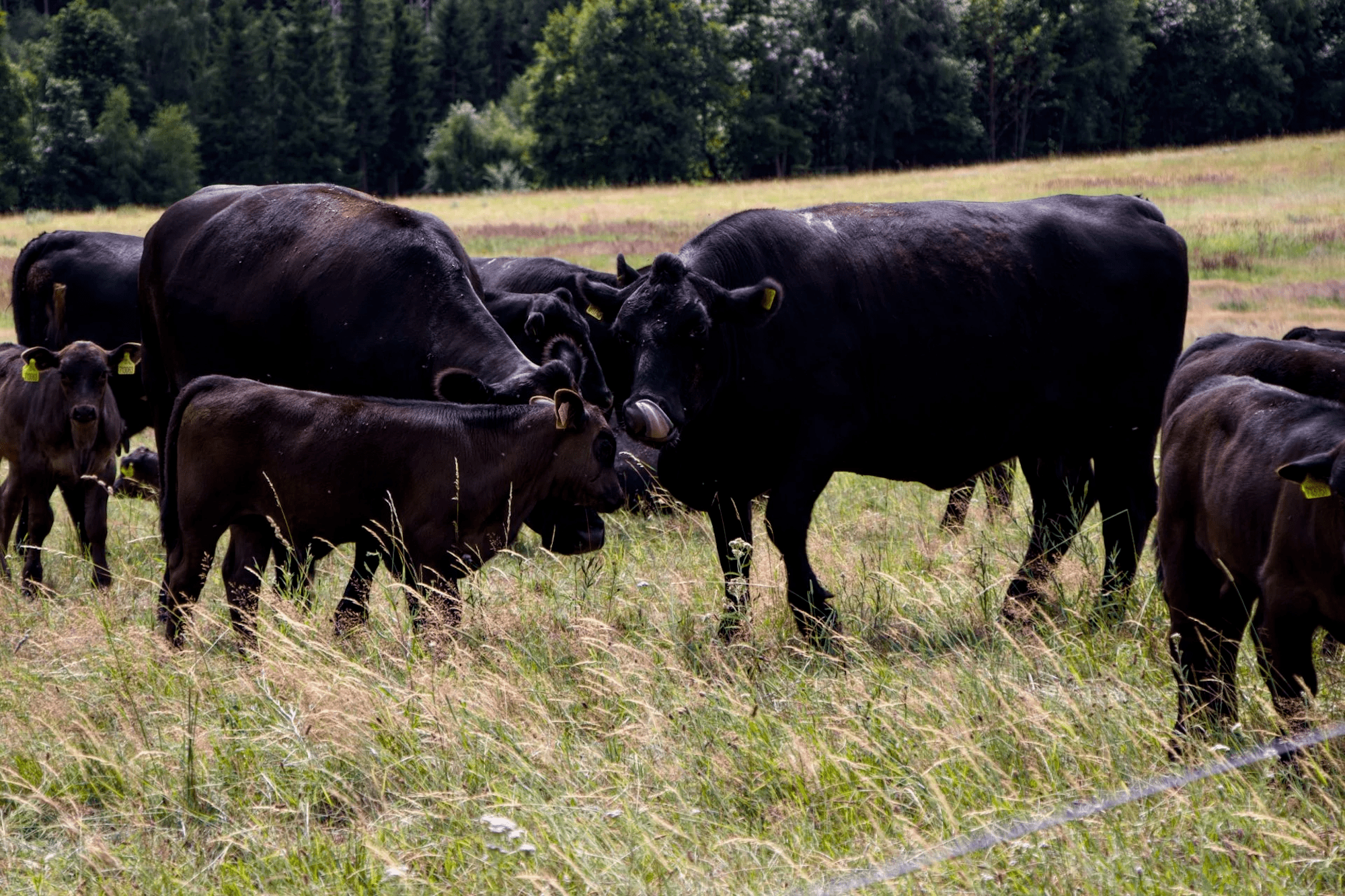
The cows come when called, watching curiously; most are on their feet grazing. A portable shelter and water tanks stand in one corner of the pasture. Lobkowicz started with 19 animals; today the herd has 30 mothers and the same number of calves.
“If you give a herd free access to the entire pasture, the cows will only choose the tastiest third. This puts constant pressure on the most fertile part, which depletes the soil. When a herd is in a smaller area for only 24 hours, the animals instinctively graze over everything in front of them – they have no choice. Moreover, the onslaught only lasts 24 hours, not several days,” explains Lobkowicz.
Moving Cows Saves Money
Every day at 4 p.m., the animals move to a new section of pasture. Its size varies throughout the year – about 1.5 hectares in spring, half a hectare in summer, and larger again in autumn. The cows won’t be back where they are today until two months later.
This gives the grass ample time to regenerate. “Ordinary roots are usually no more than 20 centimeters long and are washed away by every rain. While here they are up to one and a half meters long,” Lobkowicz says.
Moving the animals takes about two and a half hours a day on average. It depends on whether Lobkowicz is preparing the pasture for the next day and whether the animals can be moved as one group or individually, by vehicle. “It’s sometimes 10 minutes and sometimes easily two hours,” he adds.
Pasture productivity has more than tripled, the farmer says. Today, there can be twice as many animals on one hectare, and the area can support them without any problems. “I want to have them graze as long as possible. In Central Europe, we can normally graze animals for half the year, but we have to supplement them for the other half, and that costs money,” he notes.
His cows used to graze from mid-May to mid-September. Now he lets the animals out at the beginning of April and they stay there until the end of November, and last year even until December.
Lobkowicz doesn’t use any machinery like mulchers or mowers, and instead rides his four-wheeler around the fields to damage the soil as little as possible. “It weighs half as much as a cow, so the soil doesn’t even feel it,” he laughs.
Cows Don’t Stand in the Mud
The experience from Drahenice is confirmed by a 2020 review study in a scientific journal, Frontiers in Sustainable Food Systems, which summarizes the results of various research projects investigating grazing with frequent movement in Argentina, Australia, Germany, South Africa, and the United States. The study found that frequent herd movements lower costs and raise yields over time while storing carbon, because such practices support the retention of carbon in the soil and the retention of water and nutrients, while reducing erosion and increasing biodiversity from microbes to insects, wildlife, and birds.
A study by the European Alliance for Regenerative Agriculture confirmed such increases in productivity. Researchers analyzed the management of 78 farms in 14 European countries between 2020 and 2023. Regenerative farms achieved an average of one-third higher total productivity than conventional farms. Plant diversity increased by 16 percent.
The vegetation composition of Lobkowicz’s pastures has changed over the years. Legumes have increased, which act as natural fertilizers. New species of birds – such as partridges, quails, black storks, corn cakes, and Eurasian hoopoes – as well as insects have started appearing.
“It’s interesting that you don’t have to do anything special for them to come back – just restore natural conditions. What makes me happiest is that my farm is alive,” he says.
Even his neighbors have noticed the changes in Lobkowicz’s pastures. “One of them complimented me because my cows are the only ones that don’t stand in the mud all year round. The other one consulted me on what catch crops to grow [between the main crops],” he says.
“Everyone around me has already started with [the catch crops]. But it’s probably only the next generation that will have the courage to try regenerative agriculture. As long as the conventional method is financially viable, there’s no reason for them to change anything,” the farmer reckons.
Regenerative Grazing May Not Work Everywhere
Martin Nejdl from the area around the town of Klatovy, whose family farm raises Aberdeen-Angus cattle, is one of the skeptics about regenerative grazing. He notes that the regenerative approach may not work everywhere. That is why he sticks to the system that has brought him good results in the long term.
He emphasizes that his experience from more than 20 years of breeding shows a different path. “The cows will tell you themselves, because they don’t want tall grass,” he says. According to him, herds thrive better on lower growth, young grass, ideally around 10 to 20 centimeters. For him, the key is the balance between the animals’ needs and the state of nature.
His animals also never stay in one area for long, with the herd of 50 cows moved on average every two weeks. He keeps the pastures in good condition by mowing what they don’t eat three times a season. He returns nutrients to the soil with manure and compost and adjusts so that he has enough quality grass from mid-March to the end of October.
Scientific Data for Czech Conditions is Lacking
Many conventional farmers share Martin Nejdl’s concerns. For specific Czech conditions, there is no scientific data yet available that would comprehensively evaluate the advantages and disadvantages of regenerative agriculture.
“There are a number of popularization and awareness initiatives, but this is not applied research in the true sense of the word,” explains Josef Soukup, dean of the Faculty of Agrobiology, Food, and Natural Resources at the Czech University of Life Sciences.
Research at his faculty covers principles and measures that could also be applied in regenerative agriculture. They monitor various methods for storing carbon in the soil, the balance and quality of the organic matter in the soil, and microbial communities. They also test technologies to protect the soil when growing barley or rapeseed.
“Research on regenerative agriculture as a whole would require a comprehensive and interdisciplinary approach with a huge team and also a longer-term horizon, which a grant agency would hardly cover as a regular research project,” Soukup explains.
Regenerative agriculture is a broad term. “For regenerative farmers, it is also a question of life philosophy and their approach to farming. They try to apply such measures, taking into account the specific location, to improve soil properties and maintain it in the best possible condition, which in the long term has a positive effect on production and economic indicators,” adds Soukup.
Higher Initial Costs and Slow Results
Regenerative grazing has its drawbacks and limits. “Even a regenerative farmer needs to achieve a positive economic result in order to be able to sow next year. The problem is often that improving soil properties is a long-term process lasting several years, while the production cycle, as well as economic and tax systems, are governed by annual cycles, so most farmers have to make a certain compromise in their approach to farming,” adds the scientist.
Starting with regenerative grazing can be financially demanding, because the farmer has to invest in fencing, watering holes, and shelters for the animals. In addition, the results come gradually as the soil only improves over a period of several years, which can be demotivating.
As Martin Nejdl points out, regenerative grazing is not feasible everywhere. Herders may face problems in mountainous areas or on large plots of land with poor access to water. The animals also have to get used to the stressful movement. The farmer spends more time on this each day than is necessary for routine control.
“Even some measures used in regenerative agriculture, such as reduced tillage, can generate specific problems with pests, weeds, or diseases when applied over a longer period of time,” adds Soukup.
Wenzel Lobkowicz also has experience with weeds. “Every year we put the animals in their winter enclosure and for three years we have had a certain type of weed there, while in other pastures it is almost non-existent,” he says.
That’s why, this year, he decided to mow the area with a mulcher for the first time in six years, although he had been resisting it for a long time. “I want to know if it will make a difference or if it will make the problem worse. We will see in a year. For me, it is important not to be afraid to try new things and to learn from each step,” he adds.
Crops and Cows Together
Regenerative cattle grazing has proven successful and brought good results in Drahenice, inspiring Lobkowicz to also start regenerative crop cultivation. In this, limiting plowing and using catch crops plays an important role.
Two years ago, Lobkowicz took over a neighboring farm of 120 hectares and purchased a no-till seed drill with the help of a subsidy. Unlike cattle raising, however, this is not organic farming.
“I want to get to the point where we will graze cows directly on the fields where we grow crops. It already works elsewhere, but whether it will work here, too, I have to try it myself,” the farmer says.
“With regenerative agriculture, we can do the most for nature. You, as a customer, live in the city and you can’t worry about where your wheat grows and your cows live. You have to rely on me to do it well,” he says.
Karolina Chlumecka is studying journalism at the Faculty of Social Sciences at Charles University. Her interests include sustainable fashion and community energy. This article originally appeared in Ekonews in Czech as part of the Transitions-led SoJo Europe project. Reprinted with permission.
Photos by Karolina Chlumecka for Ekonews.


