


Films touching on artistic resistance to authoritarianism lent a topical note to the Jihlava festival of documentary film as Czech lawmakers approved public media funding cuts.
“Good poems can mobilize you,”
says Ales Pojar, a 26-year-old director whose debut film, Mushroom Seconds, recently had its world premiere at the Ji.hlava International Documentary Film Festival. The documentary follows Petr Hruska, a beloved Czech poet and mushroom enthusiast, and was made possible by funding from Czech Television. Pojar said the public broadcaster approached him two years ago, while he was developing his thesis project at Tomas Bata University in Zlin, and offered to serve as a co-producer so he could shoot the story at feature length. If the government’s plan to fund public broadcasters from tax revenues rather than license fees becomes law, however, such opportunities for young filmmakers may soon dwindle.
The Jihlava festival, hosted in a medieval town in the Bohemian-Moravian highlands, is renowned for its spotlighting of up-and-coming voices in Czech and international documentary work. It celebrated its 30th anniversary this year under the theme Myslet Filmem (Thinking Through Film), a maxim that honors the rich tradition of Czech cultural figures engaging in political change in the country, best exemplified by the leadership of playwright-turned-president Vaclav Havel during the 1989 Velvet Revolution and the democratic transition.
The festival’s anniversary, however, took place during a volatile time in the country. Protests and a media strike have erupted over the government’s plan to fund public broadcasters from tax revenues rather than license fees, a move critics say could irreparably harm independent media and reduce the opportunities for young filmmakers such as Pojar.

in Jihlava. Photo by Lydia Smith
Mushroom Seconds was featured in the Czech Joy section, a category that has been around since the festival’s first iteration in 1996. Hruska, who recently served as the Frankfurt Book Fair’s guest of honor, is portrayed as a joyful sort of guy. His soft gaze is capable of finding beauty in just about anything, and a drink almost anywhere. Pojar’s film follows his dynamic personality to the Czech cities of Ostrava and Brno, and across borders to New York and Lviv in Ukraine, where he drives overnight for a poetry reading.
The decision to shoot in Ukraine “seemed inappropriate,” says Pojar. “I was so sorry for the people that are there.” But the filmmaker came to see the value in that very audience. “That inappropriate moment actually disappeared, because at the reading, it just seemed that there were people who needed poetry to listen to, and maybe they even needed us to shoot about walking through the city,” Pojar continues.
During the film’s excursion in Lviv, Hruska sits on a panel of other poets, where he expresses an unpopular affinity for Russian literature. His co-panelist, Ivan Motyl, diplomatically contends that sport and art have long been used as Russian tools for colonization. Hruska admits that if he knew someone injured by shrapnel, he might feel differently. In the greater trend of life, however, Hruska sees war as a way of simplifying life’s incomprehensible complexities. From his point of view, forgiveness for the aggression will eventually be necessary. A poet’s service comes through softening the polarizing views that define the moment.
“The enabler is the one who stays silent,”
asserts Radka Denemarkova, much-awarded novelist and screenwriter also profiled in the Czech Joy lineup. Filmmaker Slobodanka Radun takes a more global approach to addressing suppressive trends in the artistic realm in My Life for My Word, which follows a year in Denemarkova’s life during her travels to Egypt, Israel, and Taiwan.
Despite employing different formats for their language, Hruska and Denemarkova’s observations about the state of the world have much in common: both see a common, cyclical threat to freedom of expression. While Hruska might characterize his “uselessness” as the thing that sets him free, Denemarkova’s writings have earned her a lifetime ban from China for her work in Taiwan.
“If literature can do anything, it’s to give a voice to those who don’t have one,” she says in the film. She believes the writer is meant to serve the people, not the government. Yet, it happens time and time again that regime changes target independent journalists, writers, and artists. And there is no political recipe for success. “Communism brainwashed us, capitalism is heart-washing us,” she laments. “Rough capitalism weakens democracy.”
In between screenings at the DKO and Dukla Cinemas in Jihlava, the festival offered a variety of Czech- and English-language panels. These included discussions about how Czech Prime Minister Andrej Babis has used his time in power, the negative effects on small businesses of map apps like Google Maps, and the use of ironic humor to make sense of the times. Hot, vegan meals were served all day and beer flowed into the night, all while techno music pulsed from DJ booths. There were also dedicated spaces for children’s programming, making the event accessible and welcoming for visitors of all backgrounds.
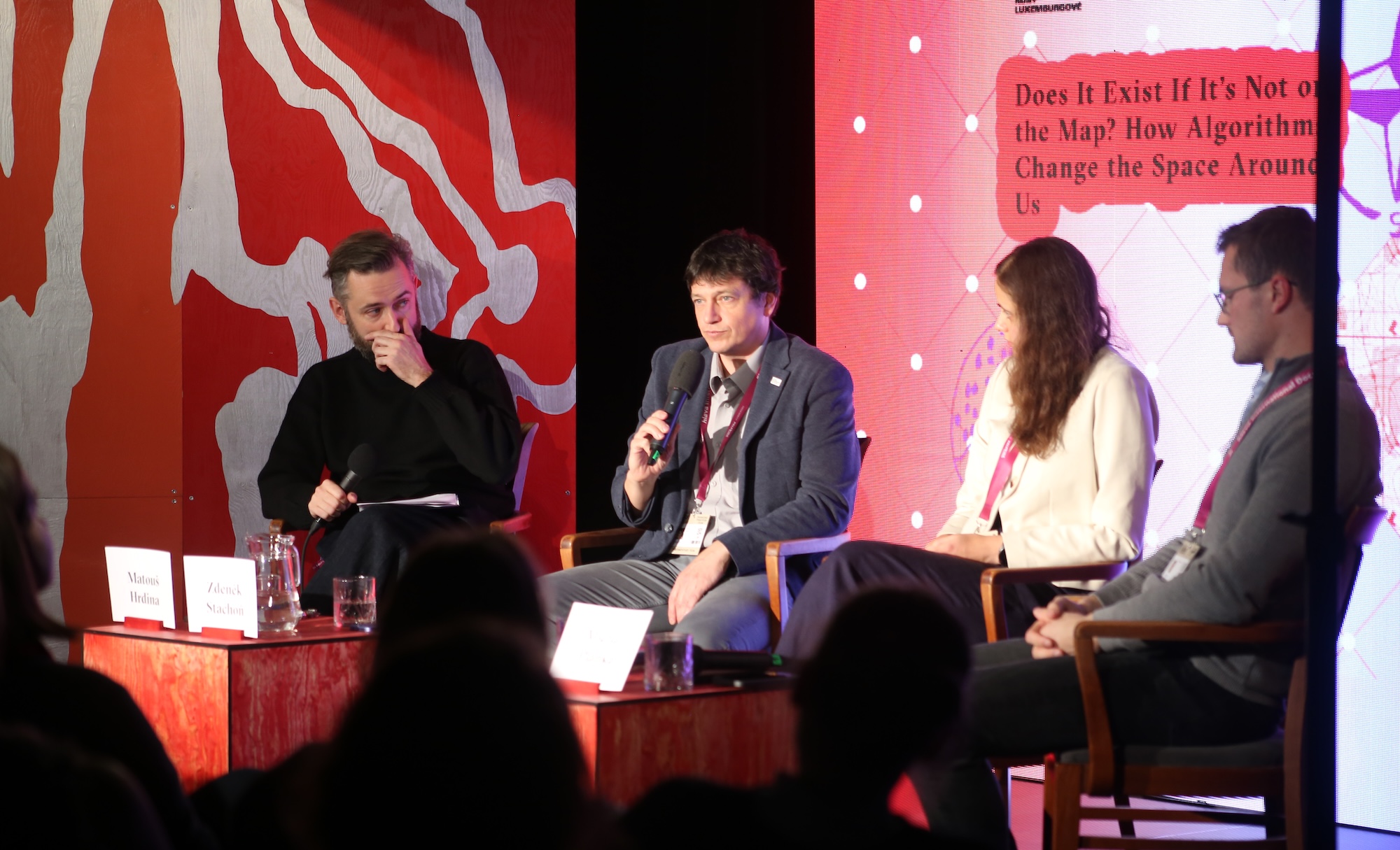
Ji.hlava co-organizer and programmer Andrea Slovakova has been with the festival for 26 years and served as the dean of Prague’s renowned FAMU film school from 2020 to 2024. A notable voice in the appeal to make documentary film more visible to Czech audiences, she explained that, in addition to the roughly 4,000 submissions the festival received for this edition, the event continues to build out its program by leveraging relationships with film schools, art galleries, and Czech Television.
“Public service television is the main co-producer of documentary films,” she says. “It is one of the strongest partners of the festival.” Each year, Ji.hlava screens several dozen Czech Television–supported films. In Pojar’s case, Mushroom Seconds runs 84 minutes in the cinema, but it also has a shorter cut that has been strategically edited for broadcast. Though there may be some negative stereotypes about the formulaic nature of “made-for-TV” documentaries, Slovakova is adamant about pushing the boundaries of the genre: “It’s not only television content – it’s a creative film that belongs on a big screen.”
To mark the festival’s three decades of existence, Slovakova and editor Janka Vlckova created five short films comprising interviews and masterclasses from Ji.hlava’s past. The project required sorting through a hundred hours of footage, but she was surprised to find that many other sessions she remembers were never even recorded. These films include videos of documentary pioneers such as Karel Vachek, Frederick Wiseman, and Bela Tarr musing on the invaluable perspectives that documentary film can provide during tumultuous times.
Drawing from the Past
In My Life for My Word, Denemarkova invokes the tragic plight of famed 19th-century Czech writer Bozena Nemcova as an example of the injustice shown toward women artists in the past. Nemcova is again referenced in Jaroslav Seifert: A Rhythm Outside Time, Pavel Stingl’s part-archival, part-live action look at the Nobel Prize-winning poet and leading light of the Czech avant-garde.
Seifert’s work was cited as an inspiration for resistance during the German occupation of the Czech state during World War II. He was a Communist Party member when the party came to power in 1948. He won numerous prizes for his poetry and was even named a National Artist in 1967. However, he fell out with the regime around the time of the 1968 Warsaw Pact invasion and received a 10-year ban on publishing. He subsequently served as one of the 242 signatories of Charter 77, a pivotal civic document of dissent. In the film, a relative of Seifert speculates that he never received prison time because, “[the government] feared his authority, his poetry, and the fact that he was widely liked.”
“If a writer remains silent about the truth, he is lying!” Seifert’s voice bellows in a recording from a Czechoslovak writers’ conference in 1956. Seifert died in 1986 and thus did not live to see the Velvet Revolution, but his example paved the way. In Mushroom Seconds, Petr Hruska recites a verse of his, on the tribulations of living a long time and being forced to deal with pain:
“A young gypsy sat down beside us … I didn’t want my fortune told. I was afraid. She took my hand by force and angrily exclaimed: ‘you will live a long time.’ It sounded like a threat.”
Hands Off Our Media
Two days after the documentary festival began, on 24 October the Czech parliament was hastily called in the early hours of the morning and duly approved on the first reading a bill that would replace the mandatory license fee paid by households with direct state funding of public media through tax revenues. This would immediately result in a roughly 15 percent drop in funding next year. Critics say the legislation would mark a further consolidation of power by the populist government headed by the ANO party and its leader, billionaire Prime Minister Babis.
“1938, 1968, 2026 (?)” asked a sign carried on Prague’s Old Town Square the next day, as thousands of people braved the chilling rain to condemn the government’s proposed changes to public media funding. Pro-democracy group Milion Chvilek (A Million Moments) handed out buttons with the slogan “hands off our media” as speakers rallied the crowds. Many protestors wore hats made of newspapers – a symbol from a beloved children’s show on public Czech Television, whose budget is also at stake.
Ahead of the vote, Czech Television CEO Hynek Chudarek said that he still believed that “a functioning fee system” is the most appropriate way to finance public media. He added that “financial independence from the state is good support for the independence of the entire institution.” Under the bill Czech Television’s projected 7 billion Czech crown (288 million euro) funding from license fees in 2027 would shrink to 5.7 billion, directly allocated by the state.
The broadcaster was already planning to lay off 12-15 percent of staff over the next five years – which Chudarek justifies as a response to rising salaries and the increasing costs of purchasing outside programs. It remains to be seen how much deeper those cuts must go if the government bill passes.
‘Fundamental Revision’
Far-right parties in Babis’s coalition government have kept their pledges to keep cultural and civic organizations on a tight leash. The Culture Ministry is currently headed by Oto Klempir, a representative of the far-right Motorist party. Under another Motorist, Petr Macinka, the Foreign Ministry has already slashed its aid budget for NGOs that promote democracy and free media abroad, including Transitions.
Critics of the government’s draft arts policy unveiled in October say it could enable the Culture Ministry to curtail artistic expression and impose ideological constraints on cultural projects. The ministry is tearing up previous agreements, including one with the Karlovy Vary International Film Festival – the country’s highest-profile annual arts event – whose budget it states will be subject to “fundamental revision.”
Amid the dramatic shift in government arts policy, the future of the Jihlava festival’s funding structure may also be at risk.
The Czech Audiovisual Fund, a state-funded body that serves as one of Ji.hlava’s primary backers, is in the Culture Ministry’s sights for budget cuts, as is the Institute of Documentary Film, which provides Central and European filmmakers training and distribution, and which issued a statement expressing its concern over the future of the audiovisual industries. The audiovisual fund’s board has declared the illegality of the proposed changes. On 27 October, Klempir responded by having the fund’s chairman, Petr Dvorak, removed from his position.
Though Babis has begun to backpedal on the public media legislation, floating the idea of a voluntary license fee, the threat to film funding still looms large. “As a festival, yes, we are afraid,” admits Slovakova. But, nevertheless, “we support the public debate.” The Ji.hlava team permitted students to make political statements ahead of scheduled screenings if they desired, and allocated time for forums about how public media ought to function. “We are still critically thinking people,” she added.
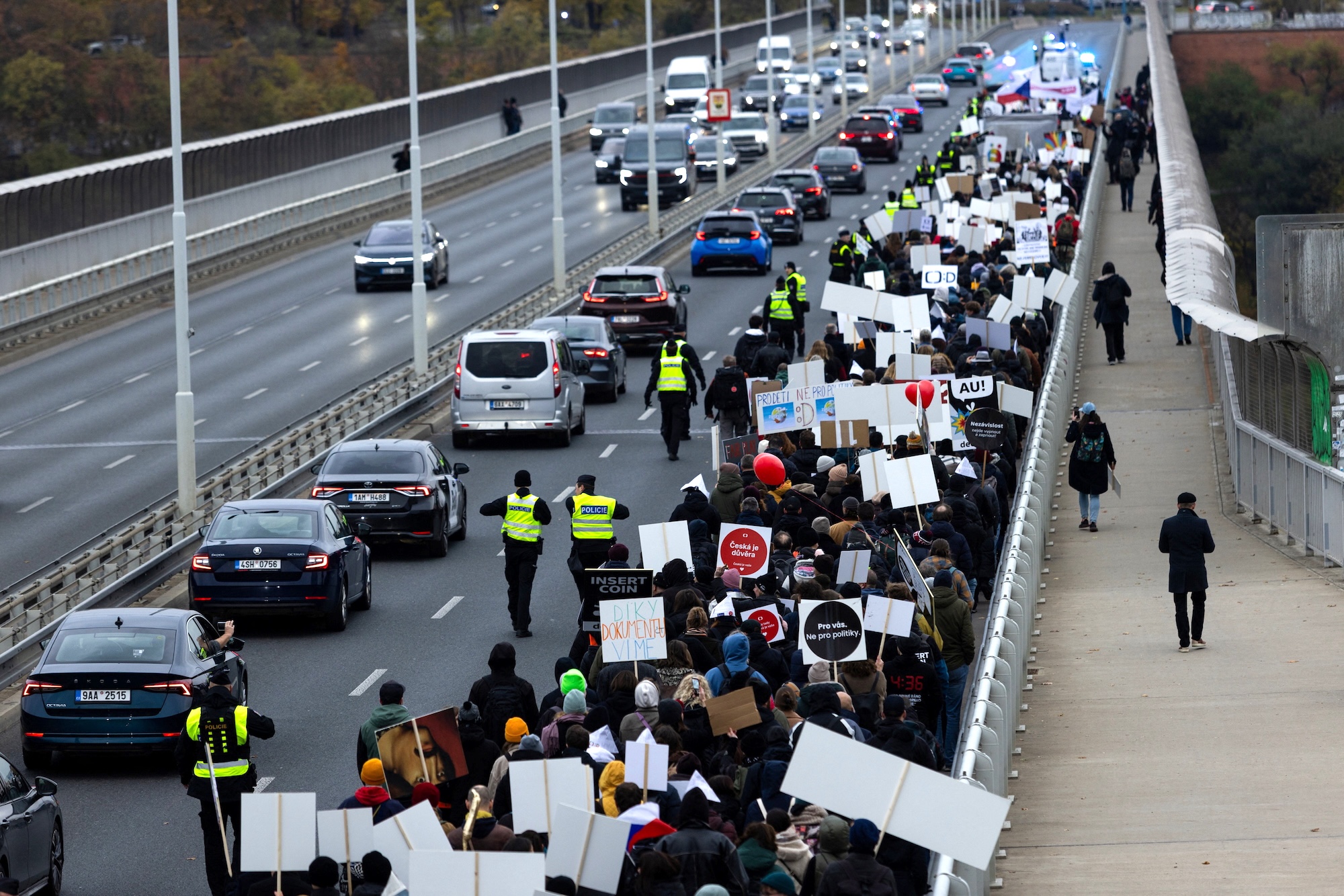
Thousands of people again filled squares in Prague and Brno on 3 November in support of a one-day strike by hundreds of public media employees. Beyond the job losses that may occur if the bill passes, strikers decried the legislation’s conflict with broader EU policy. More demonstrations by student and civic organizations are planned for 10 and 15 November, just ahead of the holiday celebrating the anniversary of the Velvet Revolution.
Slovakova vouches for Ji.hlava’s full support of the public media workers. She sees the proposed overhauls by ANO as a way to “politicize [Czech media], and to make it more obedient to the state.” She compares it to events in Slovakia two years ago, when the Culture Ministry used a law passed by the populist government to restructure the management of the public media. Ji.hlava also programmed Retuning, a film about this political shift directed by Sara Prokopova.
Ahead of the second reading of the media finance bill scheduled for January, proposals to modify it keep flying in the halls of parliament, while Babis insists he will not back away from ANO’s campaign pledge to abolish the license fee.
Poetic Politics
“The world needs me, otherwise I wouldn’t have been born,” Hruska pronounces near the end of Pojar’s film, effectively weighing in on the oft-debated social necessity of artists. Though he takes a lighter touch to existential matters than the discerning Denemarkova, who thinks “lies should be illegal,” the subjective truth of these artists, who form reality through language, presents the greatest challenge to any authoritarian state.
In the Czech context, the line between politician and artist has historically been a fluid one. At Ji.hlava, those filmmakers who self-describe as researchers are on the same level as those who identify as creatives.
On the final day of the festival, Mushroom Seconds was recognized with the Audience Award, an extra-jury prize that is voted on by attendees. The honor being bestowed on a film about an open-minded poet speaks volumes. Pojar shared his appreciation via email:
“It was unexpected for me that a student film about poetry would win an audience award. But I feel grateful that people care about poetry and about a young voice.”
Lydia Smith is the Prague-based editor of Buffed Film Buffs, a film analysis site, and a part-time editorial coordinator for Transitions Media. She previously interned with Transitions in 2023.
