


Often downplayed by Western historians, the buildup to and course of World War I in the east laid the foundation for even more traumatic events to come.
When I chanced upon a prominently displayed copy of The Blood-Dimmed Tide in the small bookshop of the small town of Sisters, Oregon, my hopes grew large. After all, it could not be easy to condense the multi-pronged and -peopled history of World War I in Central Europe into a relatively compact (230 pages) and outwardly readable volume published by a reputable academic press. And to do so with a time frame reaching back to the Russian Revolution of 1905 and forward to the 1921 Treaty of Riga, which fixed, until the fighting resumed, the crucial border between the new Polish state and the Bolshevik Russian one.
Impressively, the historian Jesse Kauffman has managed this and much more. His book is at once a coherent, chronological narrative of the “long” Great War on the eastern front (or what he prefers to call the Central European theater, where most of the fighting took place), and a discerning, in-depth analysis of what that war wrought (and how it did so) in terms of the drawn-out destruction of Europe’s German, Austro-Hungarian, and Russian land empires and the creation of national states amid the waves of violence that washed over the region, only to swell up again in the notorious “bloodlands” of the 1930s and 1940s.

Gas on a Smoldering Fire
Kauffman’s account of this ruinous “blood-dimmed tide” (the metaphorical title taken from William Butler Yeats’s 1919 poem, “The Second Coming”) is edgy and intentional: the “unknown” or “forgotten” “sideshow” of a war in the East, he writes, is often reduced to a tendentious tale of nationalism triumphant over the “creaking … yet still somehow oppressive” empires of old. What’s lost in this laudatory rendering of the nation-state’s inevitable ascent is the extent to which the outcome was, actually, “path-dependent,” which is the author’s analytical framework for the fact that the past plays out in neither wholly predictable nor boundlessly contingent ways. And while this may seem self-evident to the well-trained historian, it’s all too often obscured in academic accounts of the postwar years. In this regard, Kauffman is plain right, rather than self-righteous, when he lightly takes Timothy Snyder to task for largely omitting Central Europe’s experience in the Great War from its greatest tragedy: the unprecedented mass murders of the Bolshevik and National Socialist regimes. It’s no coincidence, Kauffman’s book convinces us, that Snyder’s map of the bloodlands “conforms remarkably closely to the outlines of the Central European theater.”
Before Hitler and Stalin sought to drastically remake the vast region, there were Russian revolutionaries (in 1905 and 1917), clashing imperial armies (more modern, well-equipped, and disciplined than we tend to credit them), territorial occupations and re-occupations, and millions of ordinary people “sucked” into the upheaval on an immensely greater scale than the Western Front. The 1905 Revolution, Kauffman shows in a chapter entitled “Before the Deluge,” was more than a political crisis for the czarist government. From the Baltics to Russian Poland and Ukraine, “it acted like an accelerant on a smoldering fire” of ethnic and social resentments, spawning and spurring assorted protest movements and pogroms that portended the war years to come and positioned key figures (like Jozef Pilsudski in Poland) for the coming fight against imperial and Bolshevik Russia both.
An Ethno-National Palimpsest
Once the “tide was unleashed” in 1914 (chapter two in Kauffman’s sweeping study), the bargaining for support from various national/political groups began. In Habsburg Galicia, for example, competing Polish and Ukrainian nationalists “self-mobilized” in order to aggrandize their people’s chances for postwar political concessions, whether within the empire or, increasingly, as autonomous nations outside of it. Nor was this a straightforward matter, as there were, to take one example, “Russophile” Ukrainians and more independently minded Ukrainians. Such endgame complexities extended, in some form, to virtually all the nationalities, which can make for rather confusing reading for one not already well-versed in the ethno-political intricacies of the region.
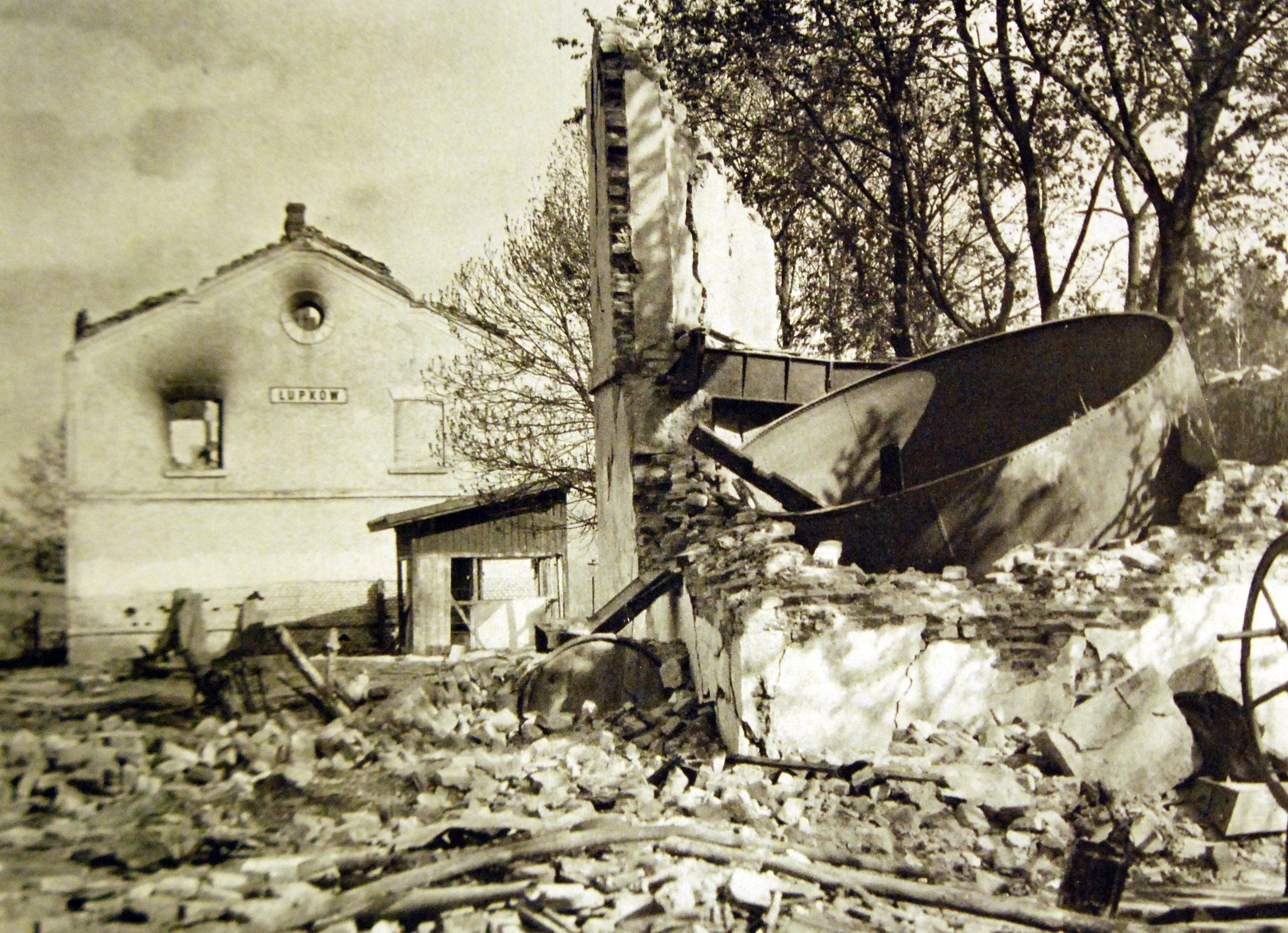
It pays off, however, in terms of grasping the book’s core contribution to our understanding of the under-appreciated eastern front: its intricate and research-laden demonstration of how the continually twisting fortunes and follies of the world war (and the Bolshevik Revolution in the midst of it, which commands its own, tidally entitled chapter: “The Russian Levee Collapses”) became predictive of certain national political outcomes.
Kauffman cannot stress enough that the establishment of a sovereign Polish state was not ineluctable, however much it might seem so. The well-organized, if politically divided, Poles pervaded the vast region. Toward the war’s end, U.S. President Woodrow Wilson also gave a direct nod to Polish independence in Point 13 of his famous Fourteen Points. Yet Polish independence was the path-dependent product of battles — revolutionary, civil, and international alike — and, to an extent, of the military and political leaders who stumbled into them. Some did so skillfully, like the czarist general Brusilov, at least at the beginning of his eponymous offensive in 1916. Others did so more carelessly, as in Kerensky’s desperate push to save his provisional government and stave off the Bolsheviks. Seeing it otherwise, Kauffman admonishes (somewhat repetitively, though it is his thesis!), “obscures, and minimizes [the war’s] powerfully destructive and transformative forces.”
Nor does this book brush over the defining nature of those forces – armies (and, interestingly, the personalities leading them). Although I would not call it a military history per se (it’s hard to put a methodological label on this roiling political, social, and, undeniably, military study), The Blood-Dimmed Tide is impressive on this count as well. Whether it’s the author’s succinct deconstruction of the Russian debacle at Tannenberg at the outset of the European conflict (largely the product of petty rivalries between military commanders – the “fog and friction” of war) or his exacting narration of the Polish–Soviet clash in 1918 (less a “miracle on the Vistula” than the product of a massive Polish mobilization effort that, extending to several fronts, “beggars belief”), Kauffman judiciously blends a breakdown of the tactical military situation with an explanation for why it so often failed to yield decisive strategic results.
All Quiet on the Eastern Front
This continual failure, which devolved into a war of attrition, can be compared fruitfully to the well-studied stalemate on the Western Front. An admirable aspect of this work is the number of times the author draws parallels to, or makes contrasts between, the two major military theaters (he should also be credited for making mention of the Russian–Ottoman front, if mainly to defend the reputation of the czar’s regularly defamed army). In most cases, the grim math grossly disfavors the eastern front, as in the large number of civilian deportations (not to mention deaths). That includes approximately 3 million Russians who had been displaced by 1915 and the unprecedented amount of Jewish dislocation and destruction. The latter receives generous and essential attention in these pages, particularly as it will directly impact the implementation of the Nazi Holocaust in the very region where the Jews were concentrated. Of course, this was the consequence of the complex ways in which national identities in ethnically mixed communities created vulnerabilities for ordinary people in the “Central European theater.” Their efforts to press for greater independence made it increasingly hard to distinguish internal from external enemies (should the Germans support the Poles against the Russians, even if that risked stirring them up in Prussia? and how were the Habsburgs to profit by playing off their loyal Polish and Ukrainian minorities?). Still, the West does not get off easily, as the ample description Kauffman reserves for the 1916 Battle of Verdun well demonstrates. After all, this long-raging and highly “industrialized” battle of attrition directly impacted military planning and progress in the east.

In this regard, one might exclaim, Kauffman overextends his already ambitious task. Indeed, besides ranging from the Baltics to Galicia, Lemberg to Posen (and Verdun to St. Petersburg!), as well as squeezing in his explanatory asides on military tactics and treaties, I admit myself to getting rather overwhelmed, if also impressed, by the sheer geographical and ethno-national scope of the study. Yet that’s the essence of this book, which is less a narrow academic monograph than a – to go with Kauffman’s aquatic analogies – swimmingly successful survey of a dauntingly vast and complicated territory caught in the clash of three powerful empires. And while specialists in fields like Latvian and Belarusian studies would certainly have more to say here, the author comprehensively (and comprehensibly) articulates the “Gordian knot of mutually exclusive [national] ambitions” that developed and evolved during the war. In the process, moreover, he manages to poke holes through some of the problematic frameworks that persist in its study. It’s simply not useful, let alone just, to view the Brest-Litovsk treaty – which ended Russia’s involvement in World War I – as yet another example of “brutal Germany” bullying “a helpless Russia.” This utterly ignores the sheer complexity of the national states and international negotiations, not the least of which were the communist ideologues at the conference table.
In a similar vein, Kauffman argues that, considering all they went through in the First World War, the newly formed states performed quite a bit better in the interwar period than the “weak and flawed” stereotypes we tend to pin on them. This is not a small point. Until we appreciate the “multiplicity of potential futures” that persisted throughout the war, we cannot imagine, let alone judge, that which transpired in its aftermath. Path-dependence as a historical/theoretical construct may be all too obvious. Nevertheless, Kauffman convincingly and, when it comes to his fellow scholars, respectfully shows that, for Central Europe in the 20th century, not to mention for understanding the Ukrainian–Russian War today (did World War I ever end in Eastern Europe? – it’s a question this work creatively raises), we would do well to be more attentive to what took place in the region when three highly militarized empires “hurtled” into one another in 1914.
Paul Miller-Melamed is a historian of modern Europe based at the Catholic University of Lublin. He is the author of several books, most recently Misfire: The Sarajevo Assassination and the Winding Road to World War I (Oxford University Press, 2022)
This article was supported by the Fund for Central & East European Book Projects, Amsterdam.


