


A young Armenian woman’s unique record of life in an Ottoman prison is now being discovered by Turkish readers 111 years on.
Sultanahmet Square is one of the most visited places on earth today. On Istanbul’s historic peninsula, the park between the Hagia Sophia and the Blue Mosque is perennially crowded. Benches are crowded with tourists enjoying the ancient architecture; the air is crowded with plumes of roasted chestnuts and corn being peddled by vendors; the cobblestone pavement is crowded by feet shuffling from one landmark to another (and the paws of street cats, on the prowl for scraps of food). Guidebooks and travel shows might lead tourists to think that this part of the city looks today exactly as it did a century, or two or three or four centuries ago. In reality, some things are missing.

Istanbul, in spite of its constant movement and population of 16 million, is full of absences: schools without students, churches without congregations, cemeteries without mourners, archives without researchers. Some absences leave no trace. The Hapishane-i Umumi, the Ottoman Empire’s first modern penitentiary, stood in Sultanahmet from 1871 until it was demolished in 1939. Tourists often mistake the nearby Four Seasons hotel for the old prison. But today’s luxury hotel was only a detention center, and of the prison, nothing remains.
One woman who passed through that prison left a blueprint for its resurrection. On visiting days, when the gate swung open to let her cross to the men’s ward and visit her father, Vartuhi Kalantar caught a glimpse of the world outside: “Sultanahmet Park, the square, the mosque, and farther away, the enchanting sea and sky of ungrateful Istanbul.” Although her memoir of the women’s ward, written in Western Armenian, was serialized in 1920 and 1921, more than a century passed before it reached Turkish readers in 2024.
The World Turned Upside Down
The first Turk to read Kalantar closely was a policeman. In the spring of 1915, when she was 20, police raided her family’s home in Istanbul and seized letters she had written home as a student in Lausanne. She was charged with, in effect, treason: The letters, some written when she was 16 or 17, voiced Armenian national feeling, and one summarized a speech she had organized in Lausanne for a prominent Armenian writer. The man who translated them into Turkish for the prosecution was Mustafa Resat, a police director who had helped make the lists for the arrests on 24 April that year of Armenian intellectuals. Those arrests are today commemorated as the beginning of the Ottoman genocide of its Armenian population. Resat read her for one purpose: to prove she was conspiring against the Ottoman state. A century later, I read her for another. Like many descendants of Istanbul’s Armenian community, I first met Kalantar in Turkish. The English translations in this essay are mine.
Kalantar came from a family of educators. Her father founded the Kalantaryan School in Bursa, a city in northwestern Turkey, the first coeducational institution to offer Ottoman Armenians both primary and secondary education; her mother, Takuhi, had run a girls’ school in Trabzon. When the police came for Vartuhi, Takuhi insisted on going with her so her daughter would not face prison alone.
Though the prosecution demanded death, Kalantar and her father, Tavit, were sentenced to life, then to five years after diplomatic intervention (Takuhi was acquitted). The father and daughter would end up spending more than two years in prison; they were freed, thanks to Tavit’s Russian citizenship, in 1918 after the signing of the Treaty of Brest-Litovsk between the Central Powers and a young Soviet Russia.
Kalantar emerged to find a completely changed world – since she was imprisoned, about a million Armenians had been killed or deported to the Syrian desert. But one consequence of the catastrophe in Anatolia was that many of the empire’s surviving Armenians ended up in Istanbul. After the Great War ended, Istanbul came under Allied occupation, attracting Armenians who hoped that they would be safer under European rule. It was in this environment that Kalantar began writing her memoirs of prison.

The occupation also briefly let Armenians publish freely. Kalantar helped found the Armenian Women’s Union, and at the invitation of the writer Hayganush Mark she wrote for its magazine, Hye Gin, which ran her prison memoir in 16 installments from March 1920 to April 1921. Neither the magazine nor Kalantar herself censored the text, the historian Lerna Ekmekcioglu has noted. It is, as far as scholars of the period know, the first prison memoir by a woman in the Middle East.
Life on the Inside
While Kalantar sat in the ward, Armenians across Anatolia were being marched toward the Syrian desert. Inside, women sang, fought, danced, and bartered. Her memoir holds both realities at once: even in the midst of genocide, life went on.
Like many epic stories, hers begins with a flood: After entering the prison, she writes, “We were swept away by a tide blended with colors and scents and found ourselves in the middle of a warm sea.” Hands search her, someone steals her purse, and by nightfall the women are drumming on an upturned trash can in honor of the newcomers.
Kalantar’s prose imagines that anyone could have been in her situation, and as she awaits her trial in the women’s ward, she places the reader inside the cell: “You realize that you want to live at any cost. You want to find a way out; you keep rehearsing what you will say in your defense.” The guard’s knock comes not when you are ready but when you have finally relaxed, watching the women play their games. “How easy death would be,” she writes, “without our loved ones.”
A Miracle by the Trash Bin
Her writing is as full of wonder as it is of horror. The most striking figure in the ward lay beside the prison’s courtyard trash bin. Kalantar first sees only “something I could not describe – more like a man than a woman, more like an animal than a man,” motionless in sun, rain, and snow, sharing scraps with the cats. Then she learns the woman’s story: a vagabond who had once, apparently, been a young beauty, wealthy and extravagant, with “the most enchanting voice and the most dizzying dances.” One day, as the women sang a ciftetelli, a fast, swaying dance tune popular across the Ottoman world, “a miracle happened. The skeleton under the leather straps slowly got up.” She waved her flea-covered sheet like a veil. Money rained down; she stuck a note to her forehead and then spun “at an incredible speed” before collapsing. In a few sentences, a woman who had lain motionless for seasons gets up and dances.
Kalantar was, by a 1917 count, one of only six Armenians among the ward’s 41 women, held captive by a state that was, outside the walls, destroying her people. Yet she was not writing to prove anything. Her first readers, Armenian women in postwar Istanbul, had lived through the catastrophe themselves; they needed no convincing. Free of the burden of proof that weighs down much of modern survivor testimony, Kalantar could write her unfiltered experience on her own terms.
Her contempt is on the page too:
A guard, his sentimentality at its peak, stood up and came over to me. He brought a large piece of dessert close to my lips with the tip of his finger. Suddenly, I felt like I had fallen into the world of monkeys. Despite my disgust and anger, I knew that if I ignored these monkeys’ attention, they would strangle me. Everyone there was looking at me with jealous eyes. I took his hand and slowly pulled it away from me, saying, “Thank you.”
“Don’t be shy, it’s very delicious,” he insisted, but the sweet treat slipped through his fingers and fell to the floor. “It wasn’t meant to be,” said the fatalistic Turk and returned to his place.
Kalantar’s disdain spills into caricature in this uncomfortable passage. But it is also the voice of a woman who no longer has to be an infallible victim or model witness.
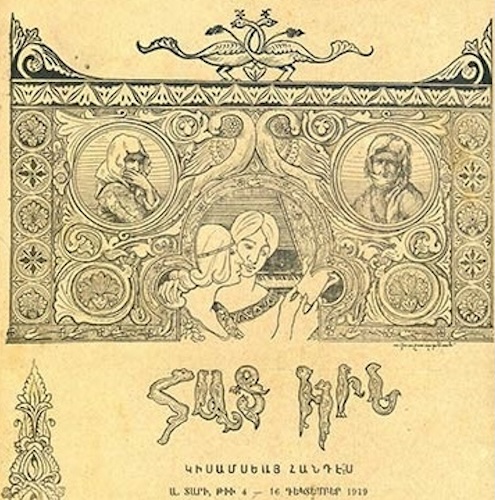
After its publication in Hye Gin, the memoir vanished. Kalantar emigrated to the United States in 1921, never to return to Istanbul. She co-wrote with her husband, Zaven Nalbantyan, under the pen name “Zarevant,” work that catalogs now credit to him alone. She died in Washington in 1978. Her personal archive remains unfound.
A Second Life in Turkish
In 2005, Ekmekcioglu was researching for her dissertation when she found a 1920 notice announcing Kalantar’s “Prison Memoirs,” with a photo of a young woman in an ornate hat, looking hopeful. In 2022, the Istanbul publisher Aras issued the memoir as a book for the first time, in Armenian. Artun Gebenlioglu’s Turkish translation followed in 2024, with an essay by Izzet Umut Celik reconstructing the long-demolished prison, and an introduction by Ekmekcioglu.
Aras was a natural home for the book. Founded in 1993 by Armenian intellectuals including Hrant Dink, who left three years later to start the newspaper Agos, it is one of the few Turkish publishers to print in both Turkish and Western Armenian, and it has made a specialty of rescuing serials from long-vanished Armenian periodicals.
The Turkish translation extended the life of Kalantar’s story. Western Armenian was the language of the Ottoman Armenians. For more than a century since, it has lived on without a state, in diaspora schools and newspapers from Beirut and Aleppo to Paris and Los Angeles, communities that war and assimilation have steadily thinned. It remains largely intelligible to speakers of Eastern Armenian, the language of the Republic of Armenia, though the two differ in pronunciation, some grammar, and spelling. UNESCO now classifies Western Armenian as endangered, and in Istanbul many Armenians read Turkish more easily than the language Kalantar wrote in.
In Turkish, the book reaches both the city’s Turkish readers and her own community’s descendants. Aras has also published historian Umit Kurt’s study of Mustafa Resat; the policeman and the prisoner he once read as evidence now sit side by side in the same bookstore.
When the Turkish edition appeared in 2024, the rights-focused news site bianet and Agos both covered it. This spring, CISST, a Turkish NGO that works on prison conditions, held a webinar on women’s prisons in the late Ottoman era, with Ekmekcioglu among the speakers. With the number of women behind bars in Turkey growing, the group turned to Kalantar’s ward to think about protecting women in prison today. The ward is gone, but the women in it have successors.
We remember 1915 through its victims, and they must be mourned. But a place remembered only through its dead becomes a city of ghosts. For many Armenians, Istanbul is indeed a city of ghosts, another casualty of the genocide: its schools without students, churches without congregations, and cemeteries without mourners are the absences this essay began with.
Kalantar’s memoir gives us back stories of how people lived amid depravity and catastrophe: women drumming on a trash can to welcome newcomers, a vagabond rising from beside the garbage to dance, a young prisoner running to the gate to see her father.
Just as we rightfully honor the dead, we are obliged to seek the experience of the living. Kalantar wrote the women’s ward so vividly that readers standing in Sultanahmet today can imagine, beneath the tour groups, a trash-can drum and a courtyard full of the polyphonic voices of Istanbul’s women.
John Klopotowski is a writer and doctoral student in the department of history at the University of California, Berkeley, studying minority presses of the late Ottoman Empire.


