

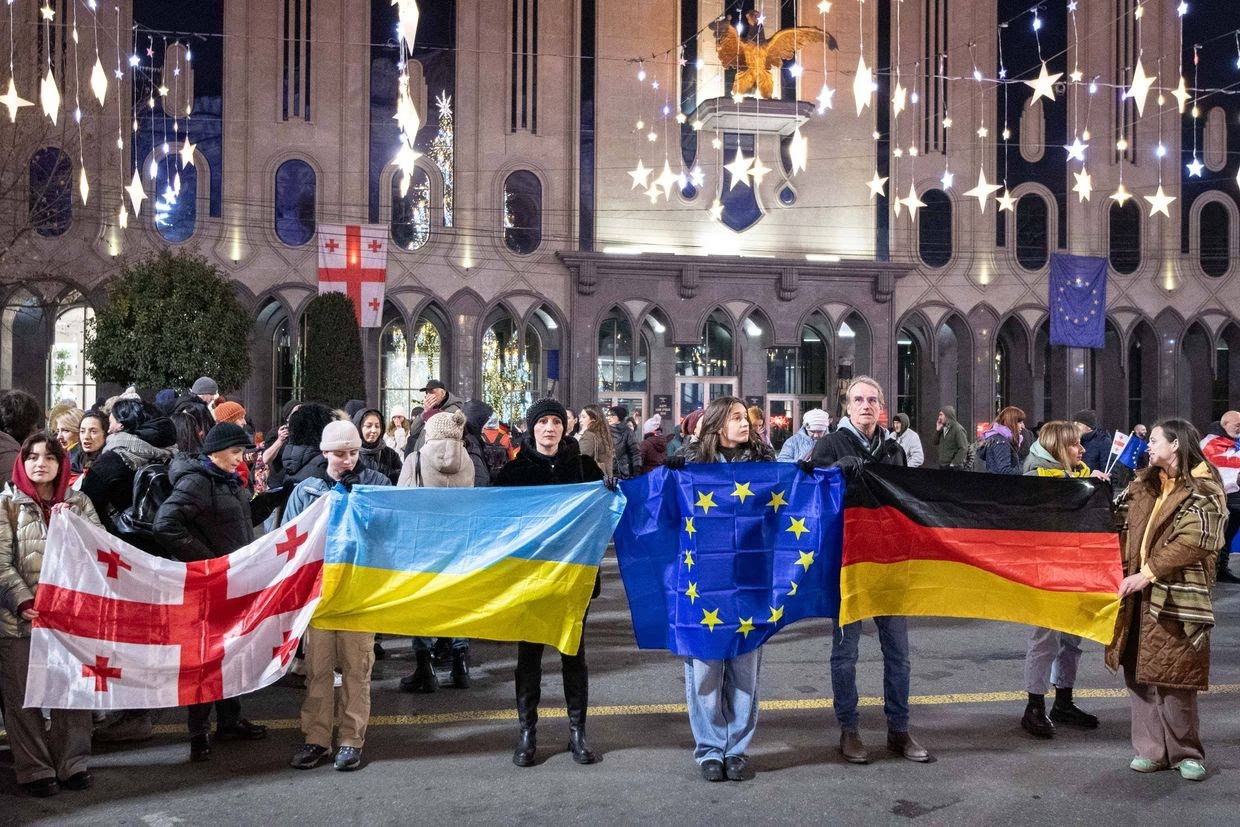
Many of the organizations have cited Georgia’s increasingly restrictive legislation as being behind the difficulties in operating. From OC Media.
In late July 2026, the Tbilisi offices of four German political foundations received pivotal emails from the Georgian government. In a brief message, all were told that their proposed projects had been rejected.
“The refusal was seen as a political move by the government, rather than a technical matter,” Shamil Shugaev, the now-former program manager at the Friedrich Naumann Foundation’s Tbilisi office, recalls.
Shugaev tells OC Media that the email they received gave no specific reasons for the “grant” rejection, stating only that the foundation’s application had failed to score enough points.

According to legislation adopted in 2025, all international grants are subject to direct government approval. In 2026, the law was tightened further, significantly broadening the definition of a grant and, consequently, the scope of funding requiring approval. In particular, funds transferred by foreign legal entities to their own branches in Georgia became subject to government approval.
“Under the current legal framework, virtually all activities of the Konrad Adenauer [Foundation] in Georgia, including maintaining an office and employing local staff, had to be submitted for approval as grants,” Stefan Reith, head of the German foundation’s Europe and North America Department, tells OC Media.
“This was an unusual situation from our perspective,” he adds.
The government has repeatedly claimed the measures are necessary to protect the country from external interventions. The process is unfolding, however, amid the ruling Georgian Dream party’s increased pressure on dissent and deteriorating relations with the country’s traditional Western partners.
The series of rejections marked a moment of crisis for the four foundations – whose South Caucasus offices in Tbilisi had been operating since the early 2000s, and in one case since the 1990s.
In October, the Naumann Foundation, as well as the Konrad Adenauer Foundation, whose project application was also rejected, announced their departure from Georgia. They joined a growing number of Western organizations that have recently left the country, some publicly and others quietly.
“De Facto Expulsion”
When announcing their departure, both the Naumann and Adenauer foundations stressed that it was a forced decision prompted by the Georgian government’s policies.
In response, Georgian Dream and pro-government media challenged the foundations, emphasizing their political affiliations: the Adenauer Foundation is affiliated with Germany’s Christian Democratic Union (CDU), while the Naumann Foundation is affiliated with the Free Democratic Party (FDP).
Georgian Parliamentary Speaker Shalva Papuashvili claimed that the government had offered the Adenauer Foundation the option of dropping its “political projects,” adding that approval would be granted for “academic or other types of projects.”
“But apparently, they have no interest in academic, scientific, or educational activities and have only a political mission,” he added.

Reith dismisses Papuashvili’s words, telling OC Media that the foundation was never invited to discuss alternative thematic priorities or adjust individual projects. He further emphasizes that they were informed “through diplomatic channels” that “further applications would have little realistic prospect of approval.”
“We were also informally given to understand that pursuing legal remedies against the rejection decisions would not be advisable,” he adds.
According to Reith, the rejected applications included both the office maintenance fees and funds for a Georgia-focused program“consisting primarily of educational, academic, and dialogue-oriented activities.”
“None of the rejected activities violated Georgian law. None advocated partisan political interests,” he adds.

Shugaev similarly highlights that the topics covered by their rejected application, from economic development to tackling corruption and strengthening political dialogue, were fundamentally in line with the Georgian government’s publicly stated priorities.
He also sees the rejections as going beyond the dismissal of individual projects, describing the government’s actions as “de facto expulsion.” Shugaev argues that it was an attempt at “pushing Germany out of Georgia in a certain capacity as an international actor […] in the sense that Germany was one of the driving forces behind Georgia’s integration into the EU.”
The other two German political foundations, the Heinrich Boell Foundation, affiliated with the Greens, and the Friedrich Ebert Foundation, affiliated with the Social Democrats, ultimately remained in Georgia despite initially suspending their operations following their own application rejections.
“Our partners really encouraged us to stay and continue our work here because they see us as a bridge between Georgia and Germany,” Sonja Schiffers, director of the Boell Foundation’s South Caucasus office in Tbilisi, tells OC Media.
“That is why we felt that, despite the difficulties, we would try to continue our work from Georgia for as long as we felt we could fulfill our mission,” she adds.

The exact circumstances that made it possible for two foundations to stay have not been officially explained. However, the German newspaper Frankfurter Allgemeine Zeitung reported in early October that Martin Schulz, former president of the European Parliament and current head of the Friedrich Ebert Foundation, travelled to Tbilisi for a meeting with Prime Minister Irakli Kobakhidze to discuss the matter.
Following the visit, the Ebert and Boell foundations reportedly received a government signal that they could resubmit their grant applications, which were subsequently approved, while the Adenauer and Naumann foundations did not receive such an opportunity.
It remains unclear what criteria were used to distinguish between the foundations.
The Berlin office of the Friedrich Ebert Foundation confirmed the Schulz–Kobakhidze meeting, “during which he emphasized the importance of the work carried out by all German political foundations and their partners for the country’s democratic and social development.”

“In this spirit, we look forward to continuing our project work in Georgia, even in difficult times,” the foundation’s head of press relations, Johannes Damian, said in a written response. He also confirmed that the foundation had indeed resubmitted a proposal for its program work.
“This proposal was approved, and we expect to be able to implement our projects as planned,” he said, adding that “no changes were made to the proposal compared to the previous one.”
Schiffers, for her part, also notes that the Boell Foundation had made virtually no changes to its resubmitted application, adding that “the changes were really minor and not substantive.”
“The projects and objectives remained the same,” Schiffers says.
The Georgian government administration did not reply to a request for comment.
Threats to the Safety of Partner Organizations
In early 2025, the South Caucasus office of the Swedish women’s rights organization Kvinna till Kvinna (Woman to Woman) was already preparing to relocate from Tbilisi to Yerevan. Established in 2002, the office provided resources, including financial support, to numerous Georgian rights groups, as well as the broader women’s rights movement in the South Caucasus.
“The main reason was that the operational environment [in Georgia] became non-viable,” Regina Jegorova-Askerova, the regional director for the South Caucasus and Eastern Europe at Kvinna till Kvinna, tells OC Media.

A turning point for the organization was the adoption of the “Foreign Agents Law,” the first major piece of restrictive legislation targeting civil society, passed by Georgian Dream and its allies in spring 2024 amid protests.
The law required organizations receiving more than 20% of their income from foreign sources, with few exceptions, to register as “organizations carrying out the interests of a foreign power.” Jegorova-Askerova stresses that pushing Georgian partners to register was not an option for Kvinna till Kvinna, but neither would be asking them to circumvent the law.
Subsequent restrictive legislation, including the adoption of a law that Georgian Dream described as a direct translation of the U.S. Foreign Agents Registration Act (FARA), as well as amendments to the law on grants, further reinforced the organization’s belief that it would no longer be able to operate in Georgia.
“Our red line was the safety and security of our staff and local partners […] If we cannot legally support our partner organizations, there is nothing more we can do,” she says.
The organization had been preparing to terminate grant agreements in May 2025 with its partners and was preparing to leave Georgia when Jegorova-Askerova was denied entry into Georgia after a trip abroad in March 2025. She had lived in the country for 15 years and raised a family there.
“We never got an official reason why I was rejected,” she adds, describing the case as “clearly political” because “it’s one of many like that.” Jegorova-Askerova challenged the decision in court and participated in the trial remotely. She says she won at the first instance, but that the proceedings have continued to drag on.
Kvinna till Kvinna no longer has an office or any staff in Georgia.
Polish non-profit foundation HumanDoc, which had operated in Georgia since 2016, also cited the restrictive legal framework as the reason for its departure in early 2026. Its work included initiatives to prevent domestic violence, including what it describes as the first shelter for women and children affected by violence in western Georgia, established with a local partner, and the major renovation of a state-run shelter in Shida Kartli, in eastern Georgia.
“It was […] a [matter] of safety for us, our partners, and our beneficiaries,” the foundation’s executive director Stanisław Brudnoch says.
He tells OC Media that if their Georgian partners contacted them after the organization was deemed a foreign agent, the partners would also automatically become “foreign agents.”

HumanDoc had previously worked with both local and central government officials on domestic violence, including enforcing legislation to eliminate gaps in implementation. Its activities included training teachers, social workers, and other professionals.
With the foundation’s departure, ongoing initiatives lost support. According to Brudnoch, the shelter remains operational but on a severely reduced scale.
‘Self-isolation’
While government officials either downplay the departure of international foundations or blame the foundations themselves, those who have worked with their local offices in recent years are warning of the potential consequences.
Historian Giorgi Javakhishvili, who received a semester-based Adenauer Foundation scholarship while pursuing his master’s degree at Ilia State University (ISU), doubts the state will fill the gap left by departing international organizations that contribute to academia.
“First, there needs to be the political will, and we can see that it is lacking. More money is being spent on security agencies, police equipment, and other repressive tools, including surveillance, than on developing public institutions,” he tells OC Media.
Others suggest that the government is no longer interested in prioritizing issues that international foundations once worked on alongside Georgian officials.
“The government used to rely on the expertise of these political foundations to objectively assess the implementation of [Georgia’s] commitments to the EU,” Elguja Khokrishvili, Georgia’s environment minister from 2014 to 2015 and ambassador to Germany from 2018 to 2020, says. He joined the opposition For Georgia party in September 2024, only to leave it in July 2025 following a disagreement over the party’s participation in the 2025 municipal elections.
In his view, having “abandoned” its EU aspirations — something the ruling party constantly denies — Georgian Dream no longer needs foundations like the German ones.
Kornely Kakachia, professor of political science at Tbilisi State University (TSU), also emphasizes past cooperation between the foundations and the state.
“These [foundations] didn’t just support civil society; they also helped the government, local authorities, and others,” he notes. Georgia, he says, is gradually taking on the appearance of a “pariah state” as a result of what he describes as the ruling party’s policy of “self-isolation.”
As Schiffers concludes while discussing the Boell Foundation’s future in Georgia, even the organizations that have been able to remain in the country are facing their share of challenges:
“The overall civic space has shrunk,” she says.
Mikheil Gvadzabia is a journalist at OC Media and previously wrote for Netgazeti, where he focused on covering politics and human rights. This article was originally published in OC Media. Republished by permission.


